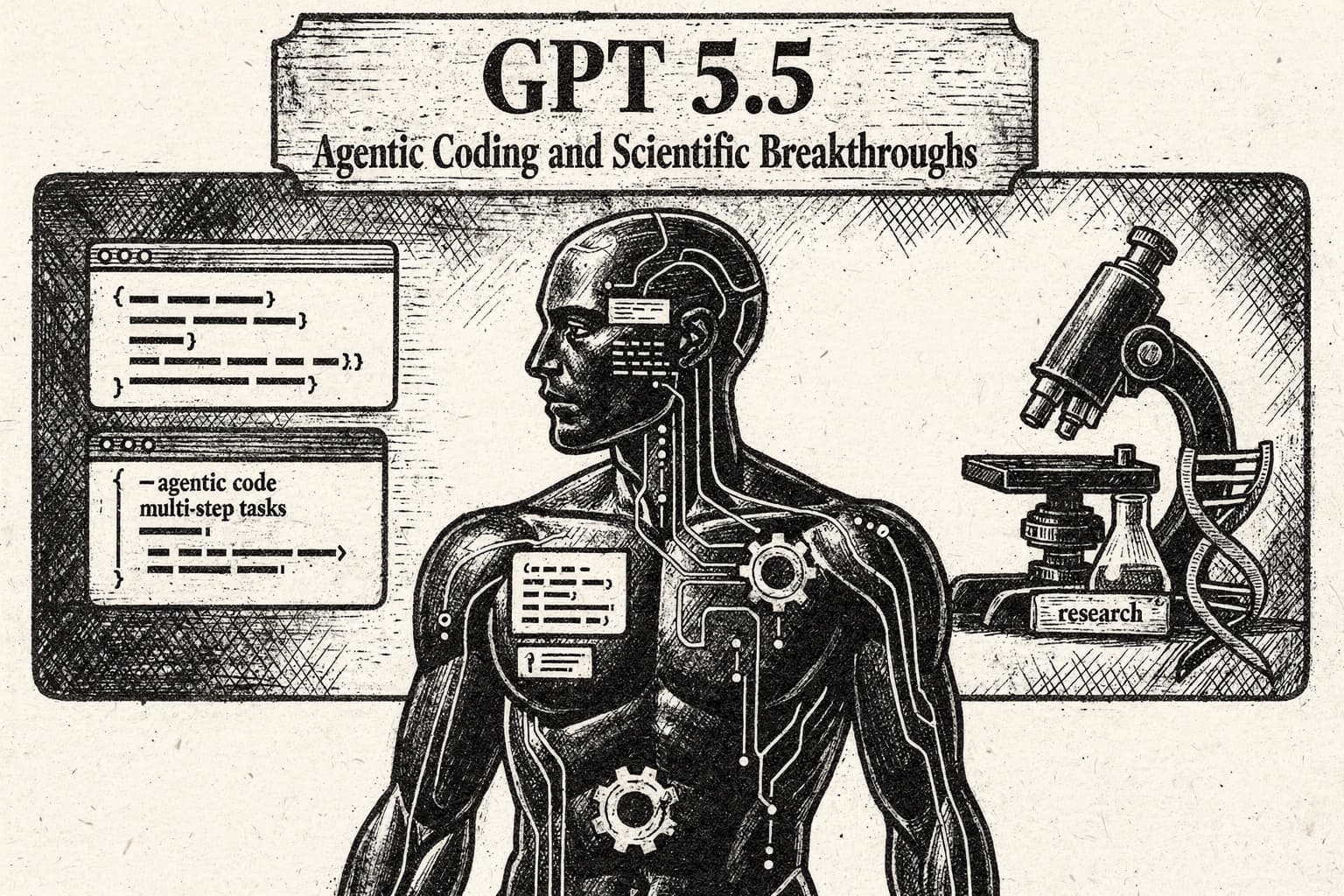
OpenAI dropped GPT-5.5 on April 23, 2026 — and the pitch is simple: a smarter model that doesn't ask you to hold its hand. OpenAI describes it as their "smartest and most intuitive to use model yet," one that understands what you're trying to do faster and can carry more of the work itself. That framing isn't just marketing — it reflects a genuine architectural shift toward autonomy.
The launch comes less than two months after OpenAI released GPT-5.4, the latest sign of the breakneck pace of development driving the AI sector. Seven weeks between major model releases is now the tempo, and OpenAI shows no signs of slowing down.
How GPT-5.5 Works
At its core, GPT-5.5 is built for agentic operation. Instead of carefully managing every step, you can give GPT-5.5 a messy, multi-part task and trust it to plan, use tools, check its work, navigate through ambiguity, and keep going. Relative to earlier models, GPT-5.5 understands the task earlier, asks for less guidance, uses tools more effectively, checks its work, and keeps going until it's done.
GPT-5.5 was co-designed for, trained with, and served on NVIDIA GB200 and GB300 NVL72 systems — a hardware partnership that directly enabled the efficiency gains OpenAI is touting. It supports a 1M token context window, image input, structured outputs, function calling, prompt caching, built-in computer use, hosted shell, MCP, and web search.
Key Performance Benchmarks
The numbers are hard to ignore. The model achieves 82.7% on Terminal-Bench 2.0 — a benchmark testing complex command-line workflows — beating Claude Opus 4.7 at 69.4% and Gemini 3.1 Pro at 68.5%. On GDPval, which tests agents' abilities to produce well-specified knowledge work across 44 occupations, GPT-5.5 scores 84.9%. On OSWorld-Verified, which measures whether a model can operate real computer environments on its own, it reaches 78.7%. And on Tau2-bench Telecom, which tests complex customer-service workflows, it reaches 98.0% without prompt tuning.
In scientific research, the model's scientific capabilities are now strong enough to meaningfully accelerate progress at the frontiers of biomedical research as a bona fide co-scientist. GPT-5.5 scores 80.5% on BixBench, a bioinformatics and data analysis evaluation, up from 74.0% for GPT-5.4, and 25.0% on GeneBench, a new evaluation focused on multi-stage scientific data analysis in genetics and quantitative biology.
When it comes to models the general public can access, GPT-5.5 has retaken the crown for OpenAI, achieving state-of-the-art across 14 benchmarks compared to 4 for Claude Opus 4.7 and 2 for Google Gemini 3.1 Pro.
Pricing
At $5 per million input tokens and $30 per million output tokens, GPT-5.5 is priced above GPT-5.4. GPT-5.5 Pro is considerably more expensive at $30 per million input tokens and $180 per million output tokens. OpenAI CEO Sam Altman argued on X that token efficiency gains offset the cost — GPT-5.5 completes the same Codex tasks with fewer tokens, which means cheaper runs even at a higher per-token rate.
Availability and Safety
GPT-5.5 is rolling out to Plus, Pro, Business, and Enterprise users in ChatGPT and Codex, and as of April 24, 2026, GPT-5.5 and GPT-5.5 Pro are now available in the API.
On the safety front, OpenAI is releasing GPT-5.5 with their strongest set of safeguards to date, designed to reduce misuse while preserving access for beneficial work. They evaluated the model across their full suite of safety and preparedness frameworks, worked with internal and external red-teamers, and collected feedback from nearly 200 trusted early-access partners before release. OpenAI has classified GPT-5.5's cybersecurity and biological capabilities as High under its Preparedness Framework, though below the Critical threshold.
What This Means for the Industry
OpenAI co-founder and president Greg Brockman claimed the new model brings the company one step closer to the creation of OpenAI's "super app," calling it a big advancement "towards more agentic and intuitive computing." The co-founders envision combining ChatGPT, Codex, and an AI browser into one unified service that can aid enterprise customers.
"We see pretty significant improvements in the short term, extremely significant improvements in the medium term," said Jakub Pachocki, OpenAI's chief scientist.
Final Thoughts
What strikes me most about GPT-5.5 isn't any single benchmark — it's the efficiency story. A model that is simultaneously smarter, faster, and cheaper to run per task is not what the industry's standard playbook predicts. Bigger usually means slower. OpenAI seems to have found a way around that, at least for now, and that's genuinely worth paying attention to.
The cybersecurity angle is also underplayed in the headlines. OpenAI classifying this model as "High" risk under its own Preparedness Framework while still shipping it broadly is a significant moment. The company is betting that responsible, wide deployment — with safeguards — is safer than keeping the capability locked away. That's a defensible position, but it's one the industry will be debating for months.
If you're a developer, researcher, or enterprise operator weighing your model stack right now, GPT-5.5 is the clearest argument yet for staying in the OpenAI ecosystem. Are you already testing it in production? Let us know what you're finding in the comments.