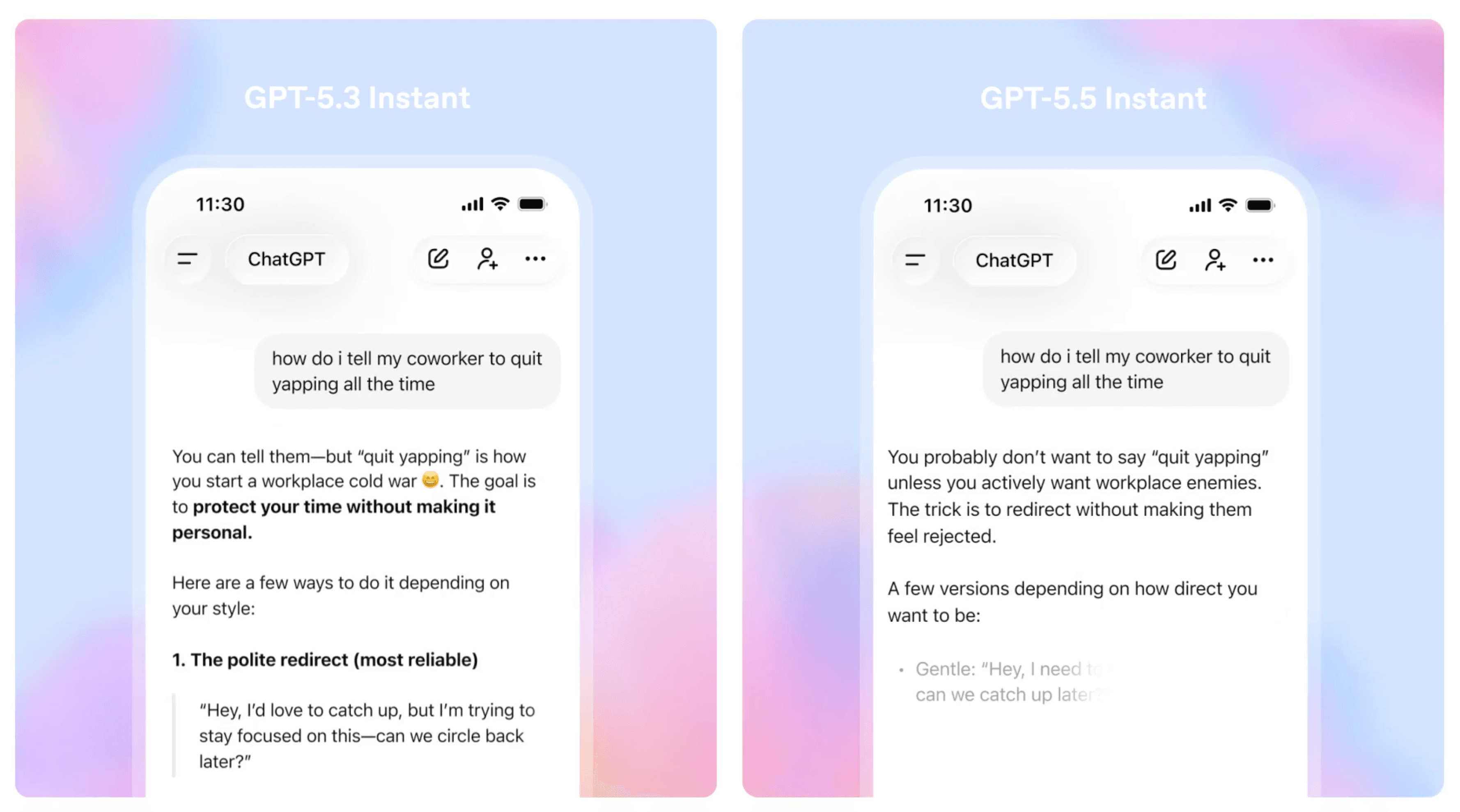
OpenAI announced on May 5, 2026 that ChatGPT's default Instant model is now GPT-5.5 Instant, replacing the prior GPT-5.3 Instant. This isn't a minor patch. The update touches factual accuracy, response length, conversational tone, and how the model uses your personal context to shape answers. If you use ChatGPT daily, you'll feel the difference immediately.
As someone who covers this beat, the hallucination reduction numbers are what catch my eye first. High-stakes domains like medicine and law are exactly where LLMs tend to fail the hardest, and this update directly targets that.
GPT-5.5 Instant is rolling out to all ChatGPT users right away, though advanced personalization via past chats, files, and Gmail is initially limited to Plus and Pro subscribers, with wider availability coming in the following weeks.
What Is GPT-5.5 Instant
GPT-5.5 is a large language model (LLM) released by OpenAI on April 23, 2026. The full GPT-5.5 family includes Thinking and Pro variants aimed at deeper reasoning workloads. The Instant tier is the fast, low-latency version designed for everyday use, and it's now what every ChatGPT user gets by default.
Codenamed "Spud" internally, it's the first fully retrained base model since GPT-4.5, meaning every model in between was an incremental update on the same architectural foundation. That distinction matters. This isn't a fine-tune on top of existing weights. GPT-5.5 processes text, images, audio, and video in a single unified architecture. Previous "multimodal" models from OpenAI were essentially separate models stitched together, but GPT-5.5 handles all modalities end-to-end in one system.
Key Technical Highlights
Here's what's actually changed in this Instant-tier update:
- Hallucination reduction: Internal evaluations show GPT-5.5 Instant produced 52.5% fewer hallucinated claims on high-stakes prompts and 37.3% fewer inaccurate claims on conversations users had flagged for factual errors.
- Conciseness: GPT-5.5 Instant is designed to be tighter and more direct, using roughly 30% fewer words while significantly reducing unwanted and unnecessary emojis and overformatting.
- Tone calibration: The model's responses are tighter and more to-the-point without losing substance, while keeping the warmth and personality that makes ChatGPT enjoyable to use. It can deliver the same information, often with more utility than previous models, while reducing the verbosity and overformatting that can make responses too long.
- Smarter context use: The model makes better use of context from past chats, uploaded files, and connected Gmail accounts when those features are turned on. GPT-5.5 Instant is reportedly better at judging when extra personalization actually helps a response, and it searches previous conversations faster.
- Safety classification: This is the first Instant-tier model classified as "High Capability" in cybersecurity and biological domains, which triggers automated safeguards typically reserved for more advanced models.
- Knowledge cutoff: All three models (Instant, Thinking, and Pro) have a new knowledge cutoff of August 2025.
Performance and Benchmarks
On AIME 2025, a competitive math exam, accuracy jumped from 65.4 to 81.2 percent. GPQA, which tests PhD-level science reasoning, climbed from 78.5 to 85.6 percent. CharXiv, a benchmark for interpreting and reasoning about scientific charts, went from 75.0 to 81.6 percent. MMMU-Pro, which measures how well models handle expert-level questions across text and images, rose from 69.2 to 76.0 percent.
The broader GPT-5.5 family also performs well on agentic tasks. On GDPval, which tests agents' abilities to produce well-specified knowledge work across 44 occupations, GPT-5.5 scores 84.9%. On OSWorld-Verified, which measures whether a model can operate real computer environments on its own, it reaches 78.7%. On Tau2-bench Telecom, which tests complex customer-service workflows, it reaches 98.0% without prompt tuning.
On the coding side, independent testing by CodeRabbit found real gains. In early testing, the agent reached 79.2% expected issue found on their curated review benchmark versus 58.3%, and improved precision from 27.9% to 40.6%. GPT-5.5 demonstrates stronger judgment in distinguishing meaningful code issues from stylistic noise, resulting in more actionable feedback, and shows improved reasoning across multi-file changes.
The New Memory Sources Feature
A new "memory sources" feature now shows users which personal context, including past chats, saved reminders, or uploaded files, informed a given response, with the ability to correct or remove individual entries.
This is a meaningful transparency improvement. Memory sources won't always show every factor behind a response. Only some chats the model searches will appear as sources, for instance. The company plans to make the view more complete over time. Memory sources aren't passed along when a chat is shared, and temporary chats neither read from nor update memory.
Availability and API Access
For developers, the GPT-5.5 model will be available through the API as "chat-latest," with 5.3 available as an option for paid users for only three months.
Enhanced personalization based on past chats, files, and Gmail is launching first for Plus and Pro users on the web, with mobile coming soon. Free, Go, Business, and Enterprise plans are expected to get access over the coming weeks.
For practitioners, default-model changes matter because they reset the baseline behavior that many end users and integrations rely on. The availability of chat-latest in the API means developers should validate behavior and cost implications in their own flows rather than assume parity with GPT-5.3 Instant.
What This Means for the Industry
GPT-5.5's Instant tier is now competing directly with Anthropic's Claude Sonnet-class models on everyday chat quality. On the higher end, the AI Security Institute described GPT-5.5 as "one of the strongest models we have tested on our cyber tasks," with a 71.4% success rate on their expert-level tasks, higher than Anthropic's Claude Mythos Preview, which had a 68.6% rate.
OpenAI notes this update does not show an increase in sycophancy compared to the previous personality of GPT-5, measured by the same internal evals. Teaching models to be warm without being sycophantic is an ongoing research challenge, and they will continue iterating to get this right. That's a direct acknowledgment of the backlash that followed GPT-4o's personality shift. When OpenAI withdrew its GPT-4o model, there was significant backlash from users who related to the model's "personality." Despite the outcry, GPT-4o was deprecated in February 2026.
Final Thoughts
The 52.5% hallucination reduction on high-stakes prompts is the number I keep coming back to. That's not a marginal gain. For anyone using ChatGPT for research, legal drafting, or medical information, the reliability floor just moved up in a meaningful way. The 30% word reduction is also more significant than it sounds for agentic workflows where token overhead compounds across hundreds of steps.
What I'd watch next is whether the conciseness claim holds up under independent testing. OpenAI argues the effective cost increase for GPT-5.5 is roughly 20% because the model uses approximately 40% fewer output tokens per task. That claim is self-reported and worth verifying on your own workloads. The same skepticism applies to the Instant tier's verbosity reduction. OpenAI's self-reported numbers have been accurate in the past, but external replication on AIME and MMMU-Pro will be the real test.
If you're a developer relying on chat-latest, test your prompts before assuming behavioral parity with GPT-5.3. Default model swaps change more than just accuracy. What do you think of the update so far? Drop your thoughts in the comments.
Frequently Asked Questions
5 questions
1What is GPT-5.5 Instant?
GPT-5.5 Instant is OpenAI's new default ChatGPT model, replacing GPT-5.3 Instant. It's the fast, low-latency tier of the GPT-5.5 family, optimized for everyday conversations with improved accuracy, shorter responses, and better personalization.
2Who gets access to GPT-5.5 Instant?
The model is rolling out to all ChatGPT users immediately. Advanced personalization features using past chats, files, and Gmail are initially limited to Plus and Pro subscribers, with Free, Go, Business, and Enterprise plans following in the coming weeks.
3How much less does GPT-5.5 Instant hallucinate compared to GPT-5.3?
According to OpenAI's internal evaluations, GPT-5.5 Instant produces 52.5% fewer hallucinated claims on high-stakes prompts and 37.3% fewer inaccurate claims on user-flagged conversations.
4Can developers access GPT-5.5 Instant via the API?
Yes. The model is available through the API as the chat-latest alias. GPT-5.3 Instant remains accessible to paid users for three more months before being retired.
5What is the "memory sources" feature?
Memory sources is a new transparency tool that shows users exactly which past chats, saved notes, or uploaded files informed a personalized response. Users can edit or delete individual entries, and memory sources are not shared when a chat is forwarded to someone else.