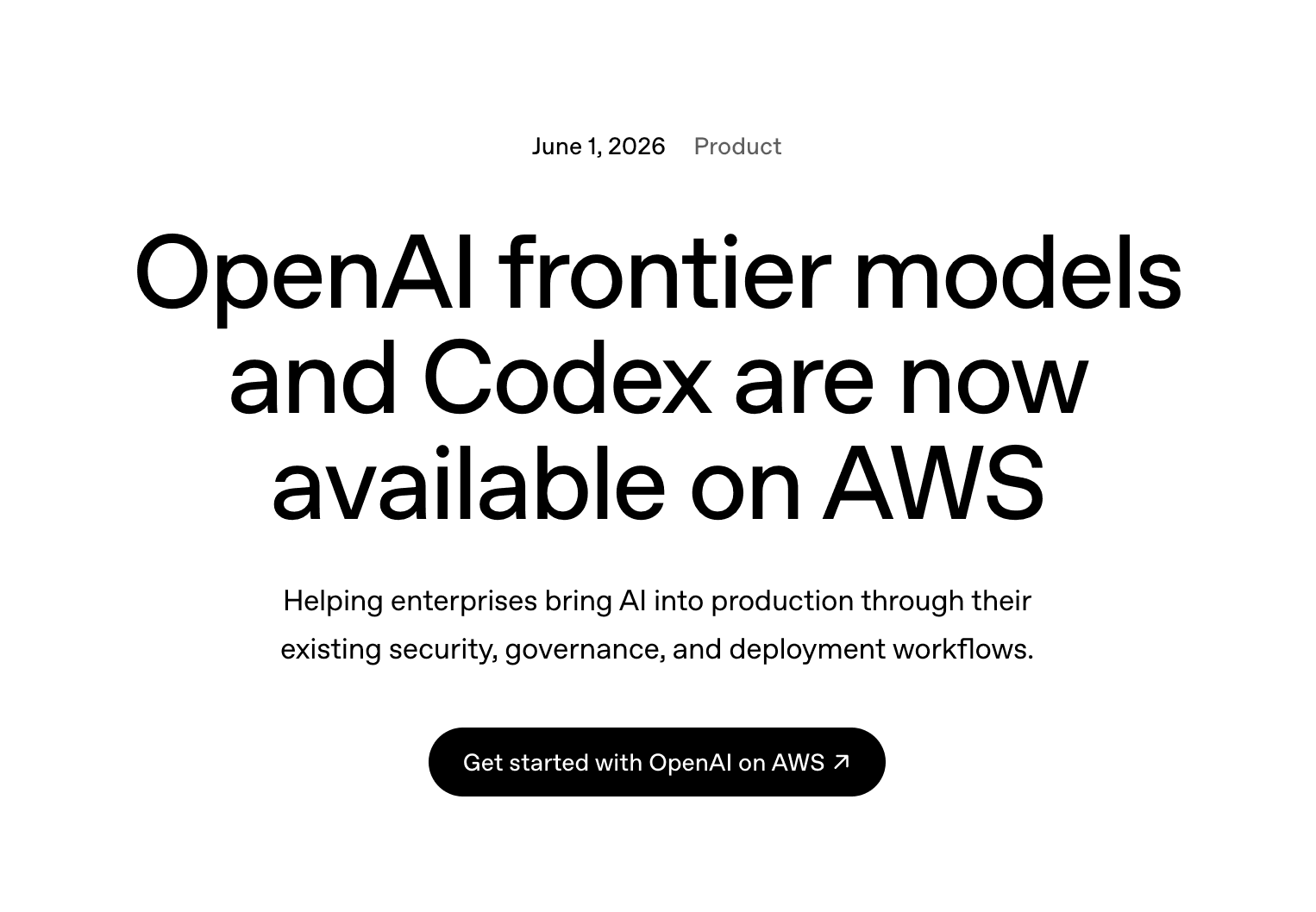
OpenAI frontier models and Codex are now generally available on AWS, opening a new path for millions of AWS customers to build with OpenAI through the platform they already use to run their business. This is a significant milestone for enterprise AI adoption. For a long time, the friction wasn't about model quality. It was about getting frontier models into production environments that already had strict security, compliance, and procurement requirements baked in.
For enterprises, this removes one of the biggest barriers to AI adoption: getting frontier AI into production through existing security, compliance, procurement, billing, and governance workflows. Customers can now bring OpenAI capabilities into AWS environments with the controls their teams already trust, helping them move faster from evaluation to real deployment.
What ended on April 27, 2026 was Azure's exclusivity. Bedrock is now the second hyperscaler authorized to distribute OpenAI's frontier models. That's a structural shift in how enterprise AI gets distributed, and it's worth paying attention to.
What Is Available on Bedrock
One month after the expanded partnership announcement, GPT-5.5, GPT-5.4, and Codex are now generally available on Amazon Bedrock, giving access to frontier models and the OpenAI coding agent for software development.
The three offerings are:
- OpenAI models on Amazon Bedrock: the latest OpenAI models, available through the same Amazon Bedrock APIs and controls customers already use.
- Codex on Amazon Bedrock: OpenAI coding agent on Amazon Bedrock, for enterprise software development at scale.
- Amazon Bedrock Managed Agents, powered by OpenAI: an optimized experience for building production-ready AI agents with OpenAI frontier models on AWS.
According to OpenAI, GPT-5.5 and GPT-5.4 models are excellent for coding, reasoning, agentic workflows, and complex professional work. You can use GPT-5.5 for the hardest customer workloads and GPT-5.4 for the best price-performance.
How the Infrastructure Works
OpenAI models on Bedrock run on Amazon Bedrock's next-generation inference engine, built for high performance, reliability, and security. Access is through the Responses API, using standard Bedrock endpoints.
OpenAI models on Bedrock inherit the full set of enterprise controls customers already depend on: IAM-based access management, AWS PrivateLink connectivity, guardrails, encryption at rest and in transit, comprehensive logging through AWS CloudTrail, and integration with existing compliance frameworks. There is no additional infrastructure to configure and no new security model to learn.
GPT-5.5 is currently available in the US East (Ohio) Region, and GPT-5.4 is available in the US East (Ohio) and US West (Oregon) Regions.
For Codex specifically, Codex is available through the Codex App, CLI, and IDE integrations, with all inference routed through Amazon Bedrock and the same security protections — including IAM, VPC isolation, and encryption — that customers already use on AWS.
Codex on Bedrock: What Changes for Dev Teams
More than 5 million people use Codex every week to write, refactor, debug, test, and validate code across large codebases. Codex holds context across entire repositories, reasons through ambiguous failures, checks assumptions using tools, and carries changes through surrounding code with awareness of how systems connect. With GPT-5.5 powering inference, Codex completes the same work more efficiently and with higher quality compared to prior model versions.
Codex on Amazon Bedrock is available through the Codex App, the Codex CLI, and IDE integrations with Visual Studio Code, JetBrains, and Xcode, with all model inference routed through Amazon Bedrock. Inference stays within your selected Region to meet data residency requirements. You pay per token with no seat licenses and no per-developer commitments, so you can get started fast and scale access as you go.
That last point matters for large engineering organizations. Moving from per-seat to pay-per-token removes a common procurement bottleneck when trying to roll out AI tooling across hundreds of developers.
Pricing and Commitments
Pricing matches OpenAI first-party rates and usage counts toward AWS commitments. There are no additional fees for running through Bedrock.
GPT-5.4 is listed at $2.50 per million input tokens and $15 per million output tokens on the OpenAI direct API, while GPT-5.5 Pro carries premium pricing at $30 per million input and $180 per million output.
Even if the token rate is the same, effective cost can change when usage counts against existing AWS commitments or moves under a centralized cloud budget. For some enterprises, that's as meaningful as a headline discount because it removes procurement friction.
Both models support a 1 million-token context window via the API, with the GPT-5.5 Codex variant offering a 400K-token window and a 1.5x faster "Fast mode" at 2.5x the standard cost.
Bedrock Managed Agents and What's Coming Next
Amazon Bedrock Managed Agents, powered by OpenAI, makes it fast to deploy production-ready OpenAI-powered agents on AWS. At the core are the latest OpenAI frontier models and the OpenAI agent harness, engineered for faster execution, sharper reasoning, and reliable steering of long-running tasks. Every agent has its own identity, logs each action, and runs in your environment with all inference on Amazon Bedrock.
For enterprises, Bedrock Managed Agents lets teams focus on making agents useful for real work, not assembling the infrastructure around them. It handles the harder parts of deployment, tool use, orchestration, and governance, with built-in integration across Amazon's security and compliance controls.
Looking further ahead, that includes future availability for Daybreak, OpenAI's vision for changing how software is built and defended. Daybreak, which includes cyber models and Codex Security, is designed to help cyber defenders see risk earlier, act sooner, and make software more resilient by design by bringing secure code review, threat modeling, patch validation, dependency risk analysis, detection, and remediation guidance into the everyday development loop.
Industry Reaction
Early adopters are already signaling intent. Amgen's CTO Sean Bruich noted that "GPT-5.5 and frontier models offer compelling advances in capability, quality, and consistency that matter in a field where the questions are complex and the standards for scientific accuracy and decision quality are exceptionally high. Making these models available on AWS gives us an important new path to explore and scale those capabilities within the responsible AI framework."
Ritesh Bansal, VP of Analytics Data, Agentic AI and AI/ML Platform at Autodesk, said their teams are "evaluating how frontier AI capabilities and AI-powered development tools on scalable, secure AWS infrastructure can help accelerate development workflows and support more informed decision-making."
On the competitive side, the most uncomfortable party in the AWS-OpenAI announcement is arguably Anthropic. AWS has been Anthropic's primary cloud partner since 2023, anchored by a $13.8 billion total investment commitment. With OpenAI now in the same catalogue, Anthropic loses its status as Bedrock's flagship frontier model.
Final Thoughts
The technical execution here is clean. OpenAI didn't build a new integration layer. They plugged into the controls enterprises already run: IAM, CloudTrail, PrivateLink, regional data residency. That's a deliberate design choice, and it's the right one for regulated industries where the approval process for a new vendor can take months.
The Codex shift to pay-per-token billing is the detail I'd watch most closely. Per-seat licensing has always been an awkward fit for developer tooling that sees wildly uneven usage across a team. Token-based billing aligns cost to actual usage, which makes budget forecasting easier and removes the hesitation around giving access to junior engineers or occasional contributors.
One risk worth flagging: enterprises routing OpenAI calls through Bedrock become doubly dependent on both AWS and OpenAI contractual terms, increasing vendor lock-in risk if either party alters pricing or access conditions. That's a real tradeoff, and any team building production workloads on this stack should factor it into their architecture decisions. What do you think? Drop your thoughts in the comments.
Frequently Asked Questions
5 questions
1What models are now available on Amazon Bedrock from OpenAI?
GPT-5.5, GPT-5.4, and Codex are now generally available on Amazon Bedrock. GPT-5.5 is positioned for the most demanding workloads, while GPT-5.4 offers better price-performance.
2Does using OpenAI models on Bedrock cost more than the OpenAI API directly?
Both GPT-5.5 and GPT-5.4 are available through the Responses API with pricing that matches OpenAI rates and no additional fees. Usage also counts toward existing AWS commitments.
3Which IDEs and tools does Codex on Bedrock support?
Codex is available through the Codex App, the Codex CLI, and IDE integrations with Visual Studio Code, JetBrains, and Xcode.
4What security controls apply to OpenAI models on Bedrock?
OpenAI models on Bedrock inherit the enterprise controls customers depend on, including IAM, AWS PrivateLink, guardrails, encryption, and CloudTrail logging.
5What is Daybreak and when is it coming to AWS?
Daybreak, which includes cyber models and Codex Security, is designed to help cyber defenders identify vulnerabilities, review code for risk, and guide remediation across the development lifecycle. A specific GA timeline has not yet been announced.