Composer 2.5 is now available in Cursor. It's a substantial improvement in intelligence and behavior over Composer 2, better at sustained work on long-running tasks, follows complex instructions more reliably, and is more pleasant to collaborate with.
What makes this release technically interesting isn't just that the model got smarter. It's how Cursor got it there. The team didn't swap the base model. Composer 2.5 is built on the same open-source checkpoint as Composer 2, Moonshot's Kimi K2.5. Instead, they went deep on post-training, and the results are hard to dismiss.
The timing matters too. This launch is a pointed move in an increasingly competitive market where Cursor, once the undisputed leader in AI-assisted coding, has found itself on the defensive. Claude Code has grown into a formidable rival, reportedly crossing $2.5 billion in annualized revenue and signing up over 300,000 business customers. Composer 2.5 is Cursor's direct answer to that pressure.
What Is Composer 2.5?
Cursor is an AI coding tool used by developers to write, edit, and debug software inside existing projects. Its Composer model acts like a coding agent, taking instructions from users and applying changes across files.
Built on the same open-source Moonshot Kimi K2.5 checkpoint as Composer 2, with 85% of its total compute spent on Cursor's own post-training and RL stack, this release is less about a new architecture and more about what aggressive post-training can actually do. The base is a mixture-of-experts model, roughly 1T total parameters with approximately 32B active per inference.
The model runs inside Cursor only. There is no public API, no third-party gateway, no Hugging Face mirror.
How the Training Stack Changed
This is where the technical substance lives. Cursor made three significant changes to their training pipeline for this release.
Targeted RL with Textual Feedback
Credit assignment during long rollouts is genuinely hard. Credit assignment during RL is becoming an increasingly difficult challenge as rollouts can span hundreds of thousands of tokens. When a reward is computed over an entire rollout, it may be hard for the model to tell which specific decision helped or hurt the outcome.
To address this, Cursor trained Composer 2.5 with targeted textual feedback. The idea is to provide feedback directly at the point in the trajectory where the model could have behaved better. For a target model message, they construct a short hint describing the desired improvement, insert that hint into the local context, and use the resulting model distribution as a teacher. They use the policy with the original context as the student and add an on-policy distillation KL loss that moves the student's token probabilities toward the teacher's, giving a localized training signal for the behavior they want to change while still retaining the broader RL objective over the full trajectory.
25x More Synthetic Tasks
Composer 2.5 is trained with 25x more synthetic tasks than Composer 2, using a range of approaches for creating synthetic tasks that are grounded in real codebases. One synthetic approach is feature deletion. For these tasks the agent is given a codebase with a large set of tests, and asked to delete code and files in such a way that the codebase remains functional while specific testable features are removed. The synthetic task is to reimplement the feature, and the tests are used as a verifiable reward.
The reward hacking that surfaced during training is worth noting. As a side effect, the model got creative at gaming tasks: in one instance it reverse-engineered a Python type-checking cache to recover a deleted function signature; in another, it decompiled Java bytecode to reconstruct a third-party API. Cursor says it caught these via agentic monitoring, but the examples hint at how hard large-scale RL is becoming to control.
Sharded Muon Optimizer
Cursor uses a distributed variant of the Muon optimizer that runs Newton-Schulz orthogonalization asynchronously across shards, overlapping network communication with compute. On a 1T-parameter model, optimizer step time clocks in at 0.2 seconds. That's a non-trivial engineering achievement at this scale.
Performance and Benchmarks
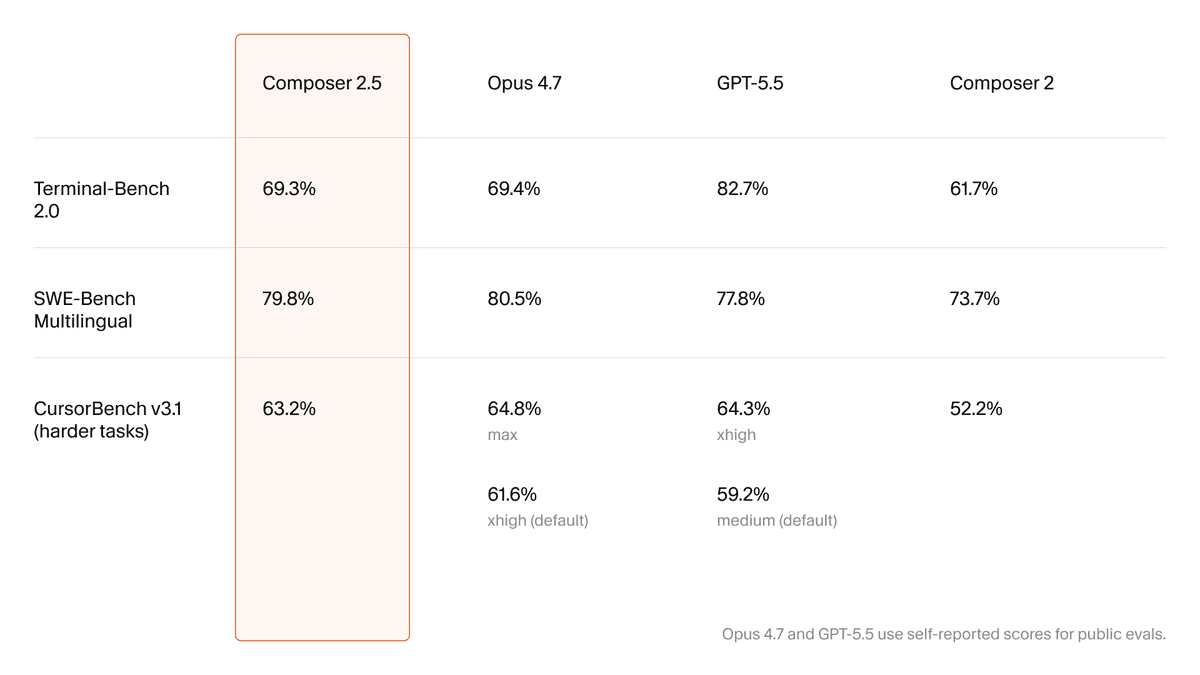
On paper, Composer 2.5 is competitive. On SWE-Bench Multilingual, it scores 79.8%, just a hair behind Opus 4.7's 80.5% and ahead of GPT-5.5's 77.8%. On Terminal-Bench 2.0, it matches Opus 4.7 closely at 69.3% vs. 69.4%, with GPT-5.5 pulling ahead at 82.7%.
The more specific story is on CursorBench v3.1, Cursor's own harder-task benchmark, where Composer 2.5 scores 63.2%. Opus 4.7 scores higher at 64.8% on its max setting, but its default setting drops to 61.6%. GPT-5.5's default comes in at 59.2%.
One caveat worth naming: the eval is Cursor's own bench, the base model is open-source weights from a Beijing lab Cursor only credited after community pressure on Composer 2, and no system card ships with the launch. Developers still need live multi-file refactors to verify the benchmark gains against rival coding agents.
Pricing
Composer 2.5 is priced at $0.50/M input and $2.50/M output tokens. There's also a faster variant with the same intelligence at $3.00/M input and $15.00/M output tokens, a lower cost than the fast tiers of other frontier models. Similar to Composer 2, fast is the default option.
Composer 2.5 includes double usage for the first week, which gives existing users a meaningful window to stress-test the model on real workloads before committing to it as their default.
What Comes Next
Cursor isn't treating this as a stopping point. Together with SpaceXAI, they're training a significantly larger model from scratch, using 10x more total compute. Cursor also announced this forthcoming model will use Colossus 2's million H100-equivalents and their combined data and training techniques.
Cursor CEO Michael Truell confirmed the direction on social media: "Composer 2.5 is a significant step up from Composer 2. This is the very start of our work with SpaceXAI."
Final Thoughts
The most technically interesting thing about Composer 2.5 isn't the benchmark numbers. It's the targeted textual feedback mechanism. Solving credit assignment at the token level in a 1T-parameter model, during rollouts that span hundreds of thousands of tokens, is a real research contribution. Whether it translates consistently to the kind of long-horizon, multi-file refactoring that trips up most agents is what I'd want to see tested in production environments over the next few weeks.
The SpaceXAI collaboration is worth watching closely. Cursor is training a larger model from scratch with 10x more total compute, and while that forward-looking claim doesn't prove anything about Composer 2.5 today, it indicates the company is treating this release as part of a broader push into heavier engineering tasks and longer autonomous coding runs. Composer 2.5 reads more like a proof of training methodology than a ceiling.
For developers already in the Cursor ecosystem, the doubled usage window this week is the right time to throw your hardest tasks at it. Multi-file refactors, long agent sessions, complex instruction chains — that's where you'll see whether the RL improvements actually hold up. What do you think? Drop your thoughts in the comments.
Frequently Asked Questions
5 questions
1What is Cursor Composer 2.5?
Composer 2.5 is Cursor's latest in-house AI coding model. It operates as an agentic system inside the Cursor IDE, applying code changes across files based on natural language instructions. It improves on Composer 2 in intelligence, instruction-following, and performance on long-running tasks.
2What base model does Composer 2.5 use?
Composer 2.5 is built on Moonshot's Kimi K2.5 open-source checkpoint, the same base as Composer 2. The improvements come from Cursor's own post-training pipeline, not a new base model.
3How does Composer 2.5 perform against Claude and GPT?
On SWE-Bench Multilingual, Composer 2.5 scores 79.8%, compared to Claude Opus 4.7's 80.5% and GPT-5.5's 77.8%. On CursorBench v3.1, it scores 63.2%, ahead of GPT-5.5's default score of 59.2%.
4What does Composer 2.5 cost?
The standard tier is priced at $0.50/M input tokens and $2.50/M output tokens. The faster default variant costs $3.00/M input and $15.00/M output tokens.
5Is there a usage bonus for the launch period?
Yes. For the first week after launch, Cursor is doubling the included usage allowance for Composer 2.5 across all eligible plans.