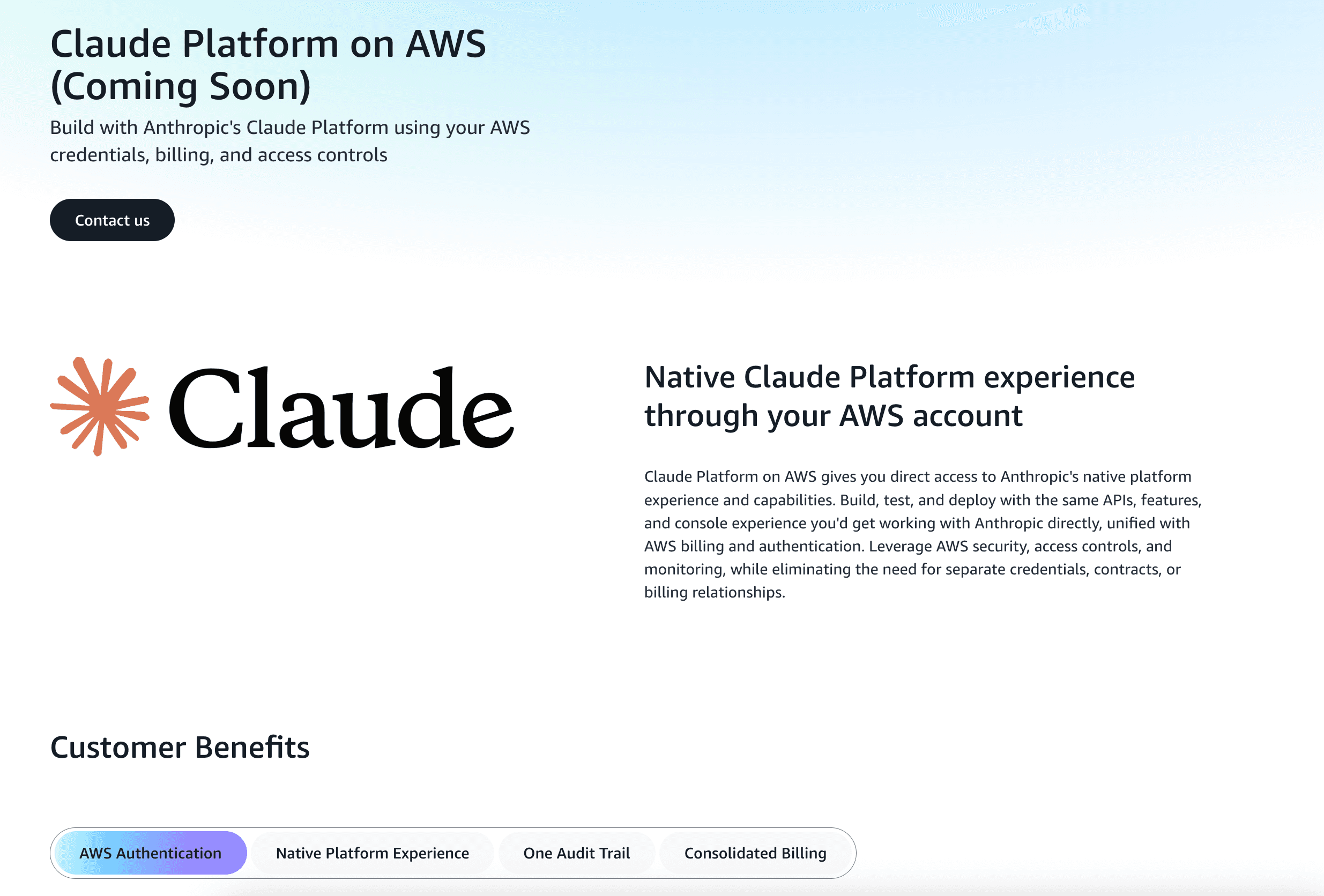
The enterprise AI landscape just shifted in a meaningful way. AWS has announced Claude Platform on AWS, a new offering that brings Anthropic's native Claude experience directly into your existing AWS account — no Amazon Bedrock required. For teams already operating inside the AWS ecosystem, this is not a minor quality-of-life improvement. It is a fundamental rethinking of how frontier AI gets procured, governed, and deployed at scale.
This is not just another model integration. It is a structural change to how enterprise teams can access one of the most capable AI platforms on the market, wrapped inside the cloud infrastructure they already trust and manage every day.
The announcement is part of a much larger strategic expansion between Amazon and Anthropic. Amazon will invest $25 billion in Anthropic over the next several years to secure more compute power. That financial commitment is backed by serious infrastructure: Anthropic is committing more than $100 billion over the next ten years to AWS technologies, securing up to 5GW of new capacity to train and run Claude. Claude Platform on AWS is the developer-facing product surface of that partnership.
What Is Claude Platform on AWS
Claude Platform on AWS gives you access to Anthropic's first-party platform — operated by Anthropic — but accessed through familiar AWS entry points: your existing IAM credentials, consolidated AWS billing, and CloudTrail audit logging.
The key distinction here is first-party. This is not Claude running on Bedrock's managed infrastructure with AWS-applied abstractions on top. Claude Platform on AWS gives you direct access to Anthropic's native platform experience and capabilities. You build, test, and deploy with the same APIs, features, and console experience you'd get working with Anthropic directly, unified with AWS billing and authentication.
Think of it as Anthropic's developer platform — the same one you'd access at api.anthropic.com — now surfaced through your AWS account's front door. The platform is still operated by Anthropic, but the entry points are all AWS-native.
How the IAM Integration Works
One of the most technically significant aspects of this launch is the authentication model. You use existing AWS credentials and IAM policies to access the Claude Platform. There are no separate Anthropic accounts or API keys to manage. Access control follows the same least-privilege and tag-based authorization patterns used across AWS.
This matters enormously for enterprise security teams. Rather than distributing Anthropic API keys across engineering teams — managing rotation schedules, secret storage, and access revocation — you manage Claude access the same way you manage access to S3, Lambda, or any other AWS service. Your existing IAM roles, permission boundaries, and organizational policies apply directly. If a developer leaves your organization, revoking their AWS access revokes their Claude access. No additional cleanup required.
You leverage AWS security, access controls, and monitoring, while eliminating the need for separate credentials, contracts, or billing relationships. For organizations already running mature IAM governance, this is a zero-friction adoption path.
Consolidated Billing and Cost Visibility
The billing consolidation story is equally compelling for engineering managers and finance teams. Claude Platform usage is billed directly through AWS, so your team can track and manage AI spending alongside your other AWS services — no separate invoices, vendor contracts, or billing accounts to manage.
This removes an operational friction point that has quietly slowed enterprise AI adoption: the procurement overhead of adding a new AI vendor. No new contract negotiations. No separate purchase orders. No reconciling two invoices at the end of the month. Claude spend lands on the same AWS bill as your EC2 instances, RDS clusters, and data transfer costs.
For organizations with existing AWS Enterprise Discount Programs or committed-use agreements, this consolidation could also unlock cost efficiencies that are simply unavailable when paying Anthropic directly.
CloudTrail Logging and Auditability
Security and compliance teams will find the CloudTrail integration to be the most immediately valuable feature. Claude Platform activity is captured directly in AWS CloudTrail, so your security teams can monitor, audit, and investigate AI usage the same way they do for any other AWS service — no separate logging infrastructure or new workflows required.
This is a significant operational win. AI usage audit trails are increasingly required for compliance frameworks — SOC 2, HIPAA, and internal governance policies all demand visibility into who accessed what and when. With Claude Platform on AWS, every API call is a CloudTrail event. You can pipe those logs into your existing SIEM, set up CloudWatch alarms on usage anomalies, and produce audit reports without any new tooling. For enterprise security teams, this integration is particularly significant. It allows organizations to deploy advanced AI models while maintaining strict adherence to existing data governance, compliance, and security policies.
Claude Platform on AWS vs. Claude on Amazon Bedrock
It is worth being precise about what differentiates these two offerings, because they serve genuinely different use cases.
Customer data on Claude Platform is processed by Anthropic outside the AWS boundary. Claude on Amazon Bedrock keeps your data within AWS infrastructure — AWS processes your data and does not share it with Anthropic or any third party.
Here is a clear breakdown of when to use each:
- Claude Platform on AWS — Best when you want Anthropic's native developer experience, access to the latest beta features, and the newest model capabilities, without needing strict regional data residency.
- Claude on Amazon Bedrock — Best when your data must stay within AWS infrastructure, you need AWS-managed features like Guardrails or Knowledge Bases, or you require PrivateLink for network isolation.
If you don't have strict regional data residency requirements and want access to Anthropic's native developer experience and beta features, Claude Platform on AWS is a good fit. Conversely, if you have strict regional data residency requirements, need your data processed exclusively within AWS's infrastructure, or require access to multiple foundation models through a single unified service, Claude on Bedrock is the right choice.
What This Means for the Industry
This announcement signals something larger than a single product launch. Claude remains the only frontier AI model available to customers on all three of the world's largest cloud platforms: AWS (Bedrock), Google Cloud (Vertex AI), and Microsoft Azure (Foundry). Claude Platform on AWS deepens that AWS relationship significantly.
For enterprise tech leaders, the Anthropic deal provides a way to streamline procurement for AWS customers who want to use Claude. It also allows them to inherit guardrails, data controls, and regional availability that they signed up for with AWS. That is a meaningful unlock for organizations where AI adoption has been blocked not by technical capability, but by procurement and compliance friction.
Anthropic and Amazon have worked closely together since 2023, and over 100,000 customers now run Claude on Amazon Bedrock. Claude Platform on AWS extends that reach to teams who need Anthropic's full native platform, not a managed subset of it.
Final Thoughts
What strikes me most about this announcement is how deliberately it targets the enterprise adoption bottleneck. The technology was never the problem. Claude is a world-class model. The friction was always organizational: separate vendor relationships, disconnected billing, siloed audit logs, and the overhead of managing yet another set of API credentials. Claude Platform on AWS removes all of that in one move.
The data residency trade-off is real and worth taking seriously. If your organization has hard requirements around keeping data within AWS infrastructure, Bedrock remains the right answer. But for the majority of engineering teams building AI-powered products who simply want the best Claude experience with the least operational overhead, this offering is hard to argue against.
The question worth asking now is not whether to adopt it, but how quickly your security and procurement teams can validate the model. Given that the entire access, billing, and audit surface lives inside your existing AWS account, that validation process just got a lot shorter. What are you planning to build first?