Most enterprise AI agent stacks today are a patchwork. A vision model here, a speech model there, an LLM stitching it all together. They still rely on fragmented model chains, separate stacks for vision, audio, and text, which increases inference hops and orchestration complexity, driving up costs while weakening cross-modal context consistency.
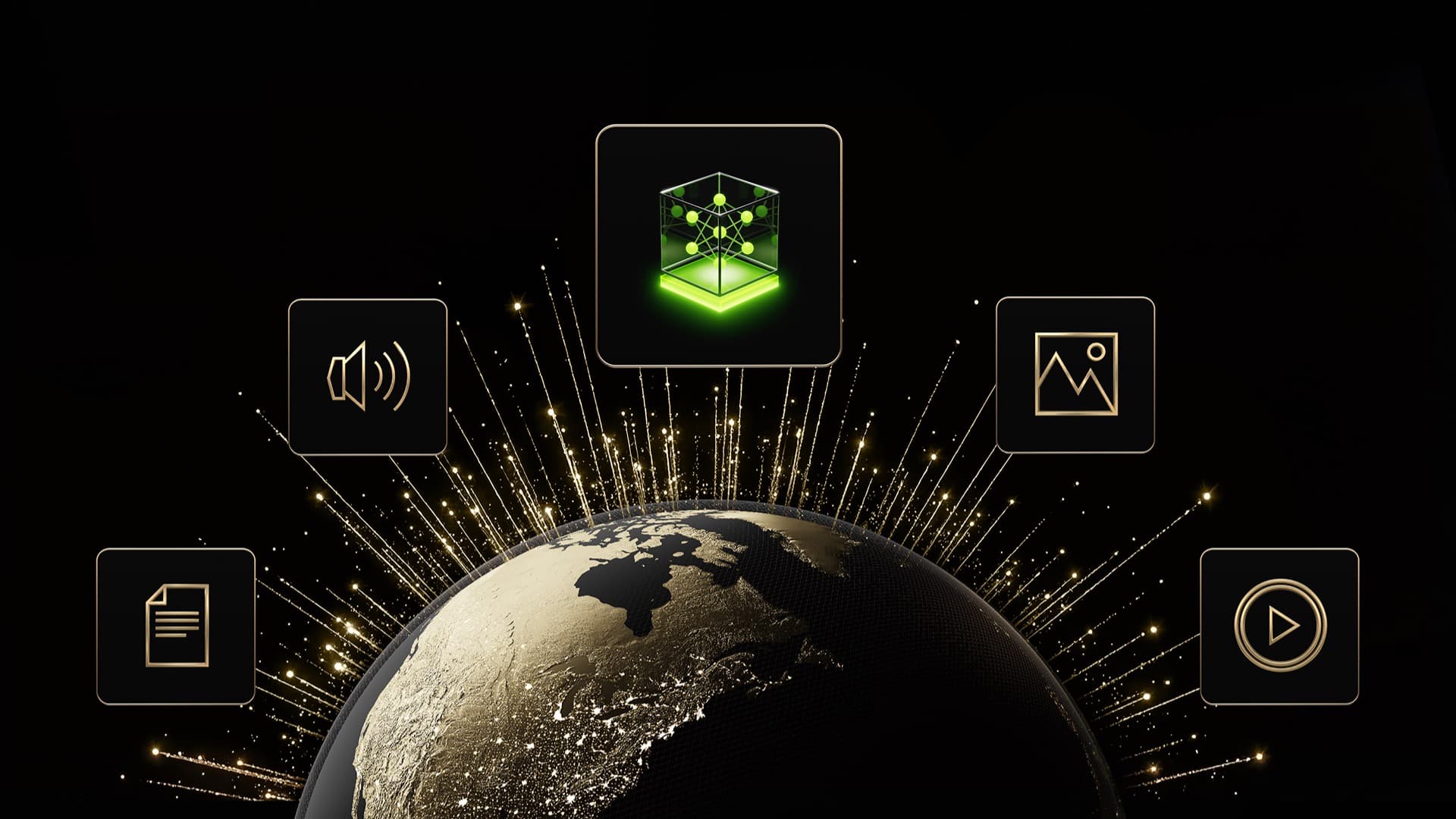
NVIDIA just shipped a direct answer to that problem. Nemotron 3 Nano Omni is an open multimodal model that brings vision, audio, and language capabilities together into one system, enabling agents to deliver faster, smarter responses with advanced reasoning across video, audio, image, and text. It's the first omni-modal model in the Nemotron 3 family, and the efficiency numbers are hard to ignore.
As someone who covers this space daily, the architectural approach here is what stands out. Collapsing a fragmented perception stack into a single model isn't just a latency win. It fundamentally changes how you build and maintain agentic systems at scale.
What Is Nemotron 3 Nano Omni?
Nemotron 3 Nano Omni is a new omni-modal understanding model built for real-world document analysis, multiple image reasoning, automatic speech recognition, long audio-video understanding, agentic computer use, and general reasoning.
It is an open, multimodal large language model with 30 billion total parameters and 3 billion active parameters (30B A3B), built on a Mamba2 Transformer Hybrid Mixture of Experts (MoE) architecture. The model supports a 131K token context and runs in FP8 precision, available for commercial use under the NVIDIA Open Model Agreement.
It is the first multimodal model in the Nemotron 3 family. The broader Nemotron 3 line already includes Nemotron 3 Super and Nemotron 3 Ultra for execution and planning tasks. Nano Omni slots in as the perception layer.
How the Architecture Works
The design choices here are worth unpacking carefully.
The model backbone interleaves three key components: 23 Mamba selective state-space layers for efficient long-context processing; 23 MoE layers with 128 experts, top-6 routing, and a shared expert for conditional capacity; and 6 grouped-query attention layers to preserve strong global interaction and expressivity.
It routes each token to six of 128 experts within a unified model, meaning vision tokens, audio tokens, and text tokens all flow through the same architecture but activate different expertise depending on the modality. That's the key efficiency lever. Only 3B of 30B parameters activate per forward pass, so you get inference economics closer to a small dense model without giving up quality.
On the encoder side:
- Images are processed at high resolution using the C-RADIOv4-H foundation model, which serves as a robust vision encoder balancing high-resolution detail with efficient computation.
- The integration of audio is built upon the NVIDIA Parakeet encoder and specialized datasets that move beyond simple transcription.
- For video specifically, the model employs 3D convolution layers (Conv3D) for efficient temporal-spatial processing and Efficient Video Sampling (EVS), which allows it to process longer videos within the same compute envelope, lowering the total cost of inference.
H Company's latest computer use agent, powered by Nemotron 3 Nano Omni, uses a native input resolution of 1920×1080 pixels to achieve high-fidelity visual reasoning.
Key Technical Highlights
- Parameters: 30B total, 3B active per token (30B-A3B MoE)
- Context length: 131K tokens, with chain-of-thought reasoning, tool calling, JSON output, and word-level timestamps for transcription tasks
- Precision: BF16, FP8, and NVFP4 checkpoints available
- GPU support: Hardware-aware optimized inference across NVIDIA Ampere, Hopper, and Blackwell GPU families
- Openness: Fully open with access to model weights, training datasets, and development recipes, enabling teams to inspect, customize, and fine-tune the model for domain-specific use cases
Performance and Benchmarks
Nemotron 3 Nano Omni tops six leaderboards for complex document intelligence, and video and audio understanding.
It delivers best-in-class accuracy on complex document intelligence leaderboards such as MMLongBench-Doc and OCRBenchV2, while also leading in video and audio leaderboards like WorldSense and DailyOmni. It achieves top accuracy on VoiceBench for audio understanding and ranks as the most cost-efficient open video understanding model on MediaPerf.
On throughput, the numbers are specific. Compared to other open omni models with the same interactivity, Nemotron 3 Nano Omni delivers 7.4x higher system efficiency for multi-document use cases and 9.2x higher system efficiency for video use cases.
On the MediaPerf tagging task, Nemotron 3 Nano Omni delivered the highest throughput (9.91 hours of video processed per hour) and lowest inference cost ($14.27) across every benchmarked model, open and closed-source.
Building on Nemotron Nano V2 VL, Nemotron 3 Nano Omni delivers substantial visual gains and adds entirely new audio and video+audio capabilities, while also leading another open-weights omni model, Qwen3-Omni, in many domains.
Agentic Use Cases
In agentic systems, Nemotron 3 Nano Omni can work alongside Nemotron 3 Super for high-frequency execution or Nemotron 3 Ultra for complex planning, as well as proprietary models from other providers, to power sub-agents for agentic workflows such as computer use, document intelligence, and audio-video reasoning.
Three primary deployment patterns stand out:
- Computer use agents: Nemotron 3 Nano Omni powers the perception loop for agents navigating graphical user interfaces, reasoning over onscreen content and understanding user interface state over time.
- Document intelligence: Interprets documents, charts, tables, screenshots, and mixed-media inputs, enabling agents to reason across visual structure and text content coherently. Critical for enterprise analysis and compliance workflows.
- Audio-video understanding: Nemotron 3 Nano Omni performs joint audio-visual analysis, both locally for specific scenes and globally across the entire video. This enables it to answer complex questions that require cross-modal reasoning, such as identifying specific visuals shown exactly when a certain topic is mentioned in the audio.
"To build useful agents, you can't wait seconds for a model to interpret a screen," said Gautier Cloix, CEO of H Company. "By building on Nemotron 3 Nano Omni, our agents can rapidly interpret full HD screen recordings — something that wasn't practical before. This isn't just a speed boost: It's a fundamental shift in how our agents perceive and interact with digital environments in real time."
Where You Can Deploy It
AI and software companies already adopting Nemotron 3 Nano Omni include Aible, Applied Scientific Intelligence (ASI), Eka Care, Foxconn, H Company, Palantir, and Pyler, with Dell Technologies, Docusign, Infosys, K-Dense, Lila, Oracle, and Zefr evaluating the model.
Deployment options are broad from day one:
- Available now on Hugging Face and OpenRouter, with SGLang and vLLM for inference, and local runtimes including Ollama, llama.cpp, and LM Studio for running GGUF checkpoints on-device.
- Major cloud service providers including Amazon Web Services and Oracle Cloud Infrastructure, with Microsoft Foundry coming soon.
- Vultr enables developers to deploy Nemotron 3 Nano Omni on dedicated NVIDIA GPU clusters as well as access it directly through Vultr's serverless inference service accelerated by NVIDIA Dynamo 1.0.
- The model can also be deployed with TensorRT Edge-LLM on NVIDIA Jetson Thor.
The Nemotron model family has been downloaded more than 50 million times in the past year, which gives this release an immediate distribution advantage.
Final Thoughts
The architectural decision to use a hybrid Mamba-Transformer MoE backbone rather than a dense transformer is the most technically interesting part of this release. Nemotron 3 Nano Omni combines state-space models, attention, and MoE in a unified design that maintains strong reasoning performance while remaining practical for long, multimodal contexts. Getting 9x throughput gains over comparable open omni models isn't just a training trick. It's a consequence of only activating 3B of 30B parameters per token, which is a real architectural commitment to inference efficiency.
What I'd watch next is how the 131K context window holds up in production document intelligence pipelines, especially against multi-page PDFs with mixed visual and text content. Through iterative pipeline development, training, and failure analysis, a series of pipelines generating approximately 11.4M synthetic visual question-answer pairs (~45B tokens) were incorporated into the final training blend. That's a serious synthetic data investment, but real-world enterprise documents are always messier than training distributions. The proof will be in how fine-tuned variants perform on domain-specific corpora.
For teams currently running separate vision, speech, and document models in their agent stacks, this is worth a serious evaluation. The open weights, full training recipes, and broad cloud availability lower the barrier to trying it considerably. What do you think? Drop your thoughts in the comments.
Frequently Asked Questions
5 questions
1What is NVIDIA Nemotron 3 Nano Omni?
Nemotron 3 Nano Omni is an open multimodal model that brings vision, audio, and language capabilities together into one system, enabling agents to deliver faster, smarter responses with advanced reasoning across video, audio, image, and text. It has 30B total parameters with only 3B active per forward pass.
2How does the 30B-A3B architecture work?
The model has 30 billion parameters but activates only three billion per forward pass through a mixture-of-experts design, a ratio that allows it to run on a single GPU while matching or exceeding the multimodal capabilities of models several times its size.
3What benchmarks does Nemotron 3 Nano Omni lead?
Nemotron 3 Nano Omni delivers leading scores across a wide range of multimodal benchmarks, including MathVista, Video-MME, OCRv2, CharXiv, ScreenSpot-Pro, MMLongBench-Doc, WorldSense, Daily Omni, MMAU, and VoiceBench.
4Is Nemotron 3 Nano Omni free to use commercially?
The release is available on Hugging Face under NVIDIA's Open Model Agreement with full commercial use rights.
5Where can I run Nemotron 3 Nano Omni?
You can run it using local runtimes such as Ollama, llama.cpp, Inference Snaps, and LM Studio for GGUF checkpoints on-device, as well as on major cloud service providers including Amazon Web Services and Oracle Cloud Infrastructure.