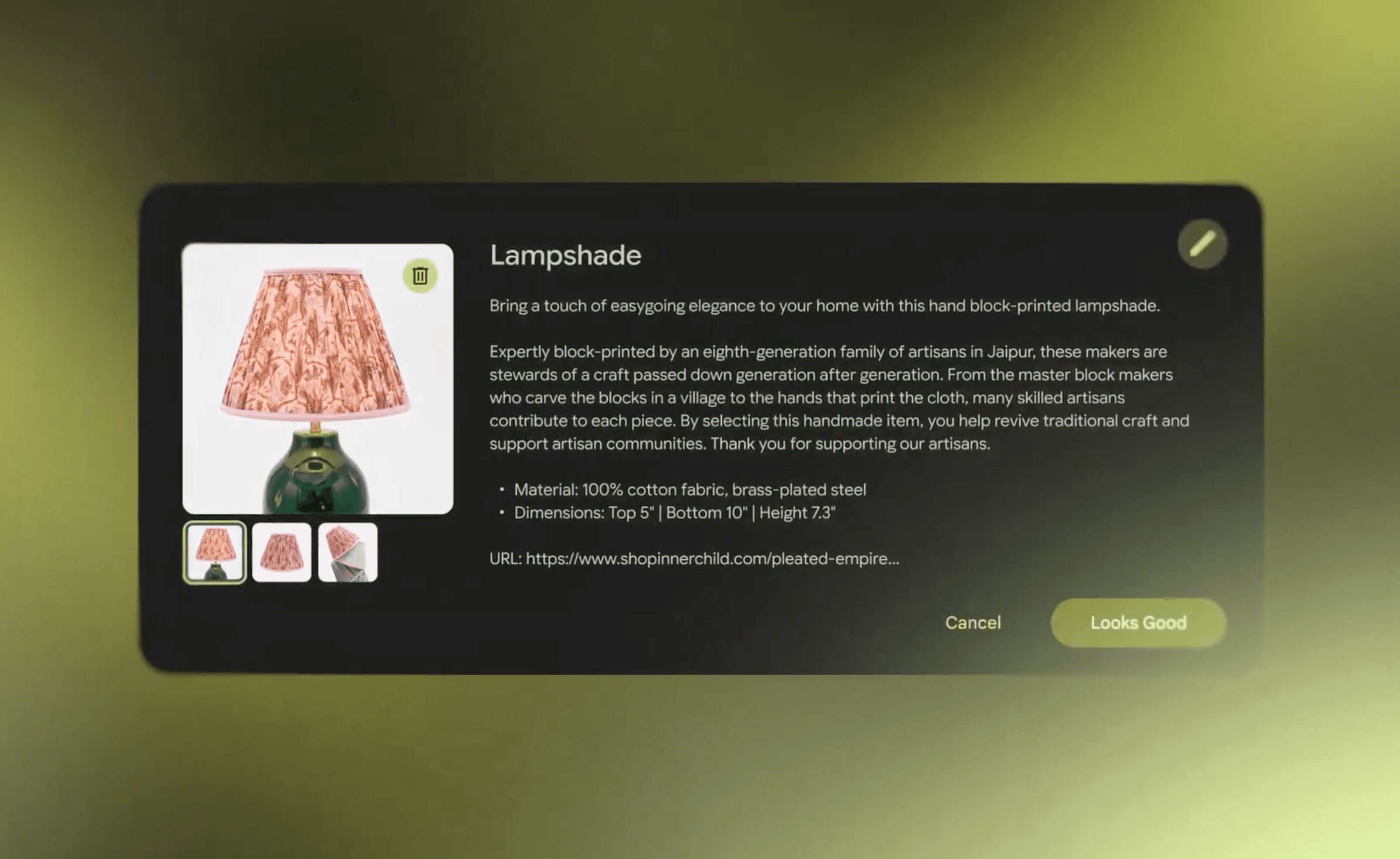
Pomelli, first launched in October 2025 as a collaboration between Google Labs and Google DeepMind, is an experimental AI marketing platform designed specifically for small and medium-sized businesses. Since then, it has grown steadily, adding Animate for video, Photoshoot for product imagery, and a global expansion that now puts it in front of merchants worldwide. The latest addition, Catalog, is the most commercially pointed update yet.
The Catalog feature would let merchants point Pomelli at a URL holding their store's product list and have the tool ingest the entire inventory in one pass. Rather than uploading items one by one, SMBs could hand over a catalog page and get back a batch of brand-consistent product shots, ad creatives, and social posts grounded in that set. For any business running more than a handful of SKUs, that's a meaningful shift in how AI-assisted marketing can work at scale.
For small to medium-sized businesses, keeping up with the demands of digital marketing can be a full-time job that they don't have the time or money to afford. With Pomelli, a free tool from Google Labs, Google wants to help these businesses grow by making it easier to generate on-brand photos and marketing campaigns that feel authentic and professional.
What Pomelli Actually Is
Pomelli is an AI marketing tool that helps you generate scalable, tailored, on-brand content to grow your business. It's a standalone web application optimized for desktop and mobile use, designed for any business with a website looking to generate marketing campaigns.
The foundation of everything Pomelli does is what Google calls Business DNA. You enter your website, and Pomelli will analyze it and create a "Business DNA" profile for your brand. By analyzing your website and existing images, Pomelli is able to automatically extract and understand your business's unique brand identity. This profile includes your tone of voice, custom fonts, images, and color palette.
The automatic brand extraction is Pomelli's biggest differentiator. No other tool in this category scans your website and builds a complete brand profile without manual input. Canva requires manual logo uploads. Jasper requires manual brand training. Pomelli does it from a URL in minutes.
What the Catalog Feature Changes
Before Catalog, adding products to a Pomelli campaign meant working with individual product URLs or manually uploading images one at a time. You could paste a product URL directly and Pomelli would pull images, titles, and descriptions from your site to generate campaigns grounded in your actual inventory. Useful, but slow for merchants with large catalogs.
With Catalog, merchants can point Pomelli at a URL holding their store's product list and have the tool ingest the entire inventory in one pass. SMBs could hand over a catalog page and get back a batch of brand-consistent product shots, ad creatives, and social posts grounded in that set, particularly useful for independent retailers without an in-house design team.
This matters because brand consistency across a large product range is exactly where most small businesses fall apart. When running campaigns across multiple channels, Pomelli maintains consistent branding without requiring manual design work for each asset. Catalog extends that same logic to the product level, not just the campaign level.
Photoshoot: The Engine Behind the Imagery
Catalog's output quality depends heavily on Pomelli's Photoshoot feature, which handles the visual side of product marketing. Photoshoot uses business context (Business DNA) and Nano Banana image generation to turn product images into a professional-grade studio shot.
Professional product photography typically costs $500 to $5,000 per product depending on complexity. Photoshoot generates comparable results for free. The templates available cover the main commercial use cases:
- Studio: adds professional lighting and clean backgrounds
- Lifestyle: places your product in realistic environmental settings
- In Use: creates AI-generated models interacting with your product
The Nano Banana model handles lighting, shadows, and reflections with real sophistication. For social media, e-commerce listings, and digital ads, early testers have described the output as genuinely competitive with professional photography.
Key Technical Highlights
Pomelli generates complete campaign packages including visual creatives, captions, and platform-specific formatting in about 60 seconds. Beyond speed, the platform offers a set of capabilities that have expanded significantly since launch:
- Natural language image editing, including commands like "change my background to a forest," style reference transfers, and improved prompt accuracy
- Pomelli Animate, launched in January 2026 and powered by Veo 3.1, transforms static marketing content into animated on-brand videos with a single click
- Marketing creatives generated with Pomelli can be downloaded and used across all social media platforms, including Instagram, TikTok, Facebook, YouTube, LinkedIn, and more
- According to Google Labs' terms of service, generated content belongs to the user, and you are free to use it for commercial purposes
Availability and Pricing
Google has been widening the scope of Pomelli, with availability in the European Economic Area, the UK, and Switzerland going live in English. This expansion lands six months after the October 2025 debut in the US, Canada, Australia, and New Zealand.
Pomelli is completely free during its public beta phase. There is no credit card required, no waitlist, and no usage limit on generations. Google has not announced post-beta pricing as of March 2026, but paid tiers are expected when the product exits beta.
The EU situation is worth noting. Availability within the European Union remains limited due to EU AI Act and GDPR regulations concerning AI-generated images. A VPN is still required from most EU countries to access the service, but the global expansion suggests that official EU availability is a matter of months, not years.
What This Means for the Industry
Catalog is not arriving in isolation. The second, more ambitious thread in Pomelli's roadmap is Websites. Still early in development, it suggests Pomelli is moving beyond static social assets toward generating landing pages or full marketing sites, with hosting potentially handled by Google itself. That would close the loop between brand analysis, asset creation, and live distribution, putting Pomelli on a collision course with Wix, Squarespace, and the wave of AI site builders including Google's own Stitch project.
Amazon already offers AI-powered product image generation for sellers through its advertising platform. Adobe is pushing AI into its Creative Cloud suite. Google, by keeping Pomelli free and tightly integrated with its own AI stack, is making a different kind of bet: that volume and accessibility beat premium features for the SMB market.
Pomelli's main goal is to democratize access to professional marketing, eliminating the need for expensive social media managers or advertising agencies. Catalog is the clearest expression of that goal so far.
Final Thoughts
The Catalog feature is the update that makes Pomelli genuinely useful for product-heavy businesses, not just service brands or solo creators. Being able to feed an entire inventory URL and get back a batch of brand-consistent campaigns and product shots removes the biggest friction point in the tool's previous workflow. That's a real improvement, not a cosmetic one.
What I'd watch next is the Websites feature. If Google can close the loop between brand analysis, campaign generation, and live web presence, Pomelli stops being a content tool and starts being an end-to-end growth platform for SMBs. That's a much larger surface area, and it puts Google in direct competition with a lot of established players simultaneously. Whether that ambition holds up in practice is the open question.
For now, if you run a product-based business and haven't tried Pomelli, the Catalog feature is a strong reason to start. You can access it for free at labs.google.com/pomelli. What do you think? Drop your thoughts in the comments.
Frequently Asked Questions
5 questions
1What is Google Pomelli Catalog?
Catalog is a Pomelli feature that lets merchants point the tool at a URL holding their store's product list and have it ingest the entire inventory in one pass, generating brand-consistent campaigns and product images from the full catalog automatically.
2Is Pomelli free to use?
Yes, Pomelli is completely free during its public beta phase. There is no credit card required, no waitlist, and no usage limit on generations.
3Which platforms can I publish Pomelli content to?
Marketing creatives generated with Pomelli can be downloaded and used across all social media platforms, including Instagram, TikTok, Facebook, YouTube, LinkedIn, and more.
4How does Pomelli learn my brand identity?
You enter your website, and Pomelli analyzes it to create a "Business DNA" profile. By analyzing your website and existing images, Pomelli automatically extracts your business's unique brand identity, including tone of voice, custom fonts, images, and color palette.
5Is Pomelli available worldwide?
On March 9, 2026, Google expanded Pomelli from its original four-country beta to over 170 countries and territories. However, EU access remains restricted due to AI Act and GDPR regulations, and the tool currently supports English only.