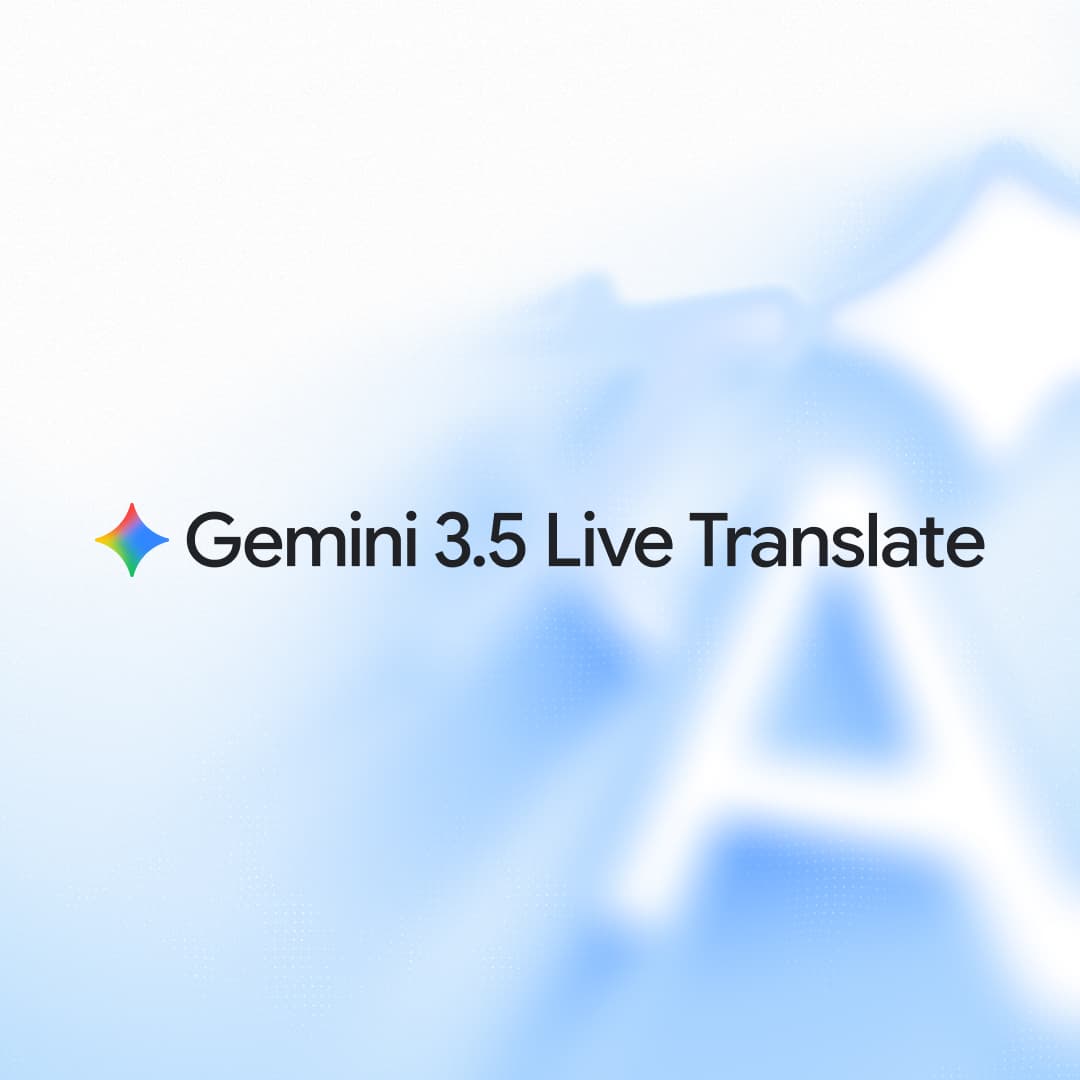
Today, Google released Gemini 3.5 Live Translate, its latest audio model for live speech-to-speech translation. This isn't an incremental update to an existing feature. It's a purpose-built model that treats translation as a streaming audio problem, not a text pipeline with voice tacked on at the end.
Twenty years ago, translation at Google began as one of its pioneering machine learning experiments. That experiment has grown to over a trillion words being translated for billions of users across Google products every month. This release is where that trajectory meets real-time voice AI.
As someone who covers this beat daily, this one is worth watching closely. The combination of low latency, voice preservation, and an open developer API puts live translation in the hands of builders in a way it hasn't been before.
How Gemini 3.5 Live Translate Actually Works
Most voice translation systems today operate on a turn-by-turn model. You speak, you stop, the system processes, then outputs. Unlike those systems that "wait for the speaker to finish speaking before responding," Gemini 3.5 Live Translate "generates speech continuously, balancing the trade-off between waiting for context to improve quality and translating immediately to stay in sync with the speaker."
Older translation systems often wait for a full sentence because early words can be misleading until later words reveal tense, intent, or context. Gemini 3.5 instead runs streaming translation, where the model listens, interprets partial meaning, predicts what can safely be translated, and keeps updating as new speech arrives.
Gemini 3.5 Live Translate is a single audio model (gemini-3.5-live-translate-preview), not a chat assistant. Developers can configure it via the Live API using targetLanguageCode and echoTargetLanguage, with audio-only input and output: 16kHz in, 24kHz out. That's a clean, minimal interface for a model doing something technically demanding.
Key Technical Highlights
The model automatically detects 70+ languages and generates smooth, natural-sounding translated speech that preserves the speakers' intonation, pacing, and pitch.
- The translated output stays a few seconds behind the speaker throughout a session.
- The model handles multilingual inputs without the need to manually configure settings.
- Its noise robustness ensures applications can handle loud, unpredictable environments.
- Audio I/O specs: 16kHz input, 24kHz output, audio-only pipeline.
- All generated audio carries an imperceptible SynthID watermark for detectability.
The SynthID watermark is worth noting. Google said all audio generated by Gemini 3.5 Live Translate is embedded with SynthID, an imperceptible watermark designed to identify AI-generated content, integrated directly into the audio output.
Where It's Rolling Out
Gemini 3.5 Live Translate is rolling out starting today across Google products: for developers in public preview via the Gemini Live API and Google AI Studio, for enterprises in private preview starting this month in Google Meet, and for everyone via Google Translate on Android and iOS.
The Google Meet upgrade carries the biggest before-and-after numbers. Speech translation in the video calling app previously supported just five languages. The model's support for 70+ languages unlocks "2000+ language combinations in one meeting, expanding from the previous state of only translating to and from English."
This month, it's rolling out in "private preview for select business Google Workspace customers," with a broader rollout coming later this year. General availability timing, pricing, and Workspace tier requirements have not yet been announced.
On Android, there's a new mode worth calling out separately. Google is rolling out a new "listening mode" with 3.5 Live Translate that lets users hear translations directly through the phone's earpiece. Simply hold the phone to your ear just like a regular call, and the translated audio streams straight to you, which can be helpful in situations where you want to quickly hear translations without others hearing.
Developer Access and Voice Agents
By utilizing the Gemini Live API, developer platforms like Agora, Fishjam, LiveKit, Pipecat, and Vision Agents enable developers to build and deploy voice translation apps with ease. These integrations handle the complex real-time media streaming infrastructure, so developers can focus on the user experience.
This is where the model becomes a primitive for AI voice agents. Developers don't have to wire up their own streaming infrastructure. They call the API, set a target language, and get translated audio back. The platforms listed above already have native integrations live.
The structure of public preview via the Gemini Live API and Google AI Studio signals that Google is positioning translation as a layer other products draw from, not only a feature it ships directly.
Pricing
Gemini 3.5 Live Translate is described as a "low-latency, real-time speech to speech translation model that supports 70+ languages." Billing is based on total input and output audio token consumption, calculated at a rate of 25 tokens per second of audio, equating to an effective price of approximately $0.0368 per minute.
For consumer use through the Google Translate app, there's no additional cost. The per-minute API pricing is what matters for developers building production voice translation products.
Real-World Testing and Industry Reaction
Google's partners at Grab are testing the model to enable multilingual communication in near real-time between drivers and travelers at pickups, with those users making over 10 million voice calls per month through Grab.
Community reaction has been largely positive, though not without caveats. One developer noted on social media that "the lag difference was night and day, Gemini barely paused between languages" when compared to routing audio through competing APIs. Others flagged that the model "still struggles with regional dialects and colloquialisms which can be difficult to model."
No independent benchmarks or third-party testing are available as of today. Google cited leading performance on the WMT25 Machine Translation benchmark for text quality, per its December 2025 announcement, but WMT25 measures written translation. Audio quality across all 70+ languages remains to be tested independently.
Final Thoughts
The streaming architecture here is the technically interesting part. Continuous speech translation that updates as new audio arrives, rather than waiting for sentence boundaries, is a hard problem. The fact that Google ships this with voice preservation (intonation, pacing, pitch) and noise robustness in the same model suggests real investment in the audio pipeline, not just a text translation model with a TTS layer on top.
What I'd watch next: translation quality uniformity across the full 70-language set. Translation quality across 70+ languages is not uniform, or at least Google's materials don't say it is. High-resource languages like Spanish and French will almost certainly outperform lower-resource ones. That gap matters a lot for the real-world use cases Google is pitching, particularly in Southeast Asia and sub-Saharan Africa.
The developer story is solid. An audio-only API at roughly $0.037 per minute, with pre-built integrations across LiveKit, Pipecat, and Vision Agents, means you can have a working voice translation agent in an afternoon. Whether the quality holds up in production at scale is the open question. What do you think? Drop your thoughts in the comments.
Frequently Asked Questions
5 questions
1What is Gemini 3.5 Live Translate?
Gemini 3.5 Live Translate is Google's latest audio model, delivering near real-time speech-to-speech translation in over 70 languages. It processes audio as it streams, rather than waiting for a full sentence to complete.
2How does it differ from traditional translation tools?
Unlike traditional translation systems that wait for a speaker to finish before producing a translation, Gemini 3.5 Live Translate continuously generates translated speech while the conversation is taking place.
3Where can I use Gemini 3.5 Live Translate today?
Gemini 3.5 Live Translate is available now for developers through the Gemini Live API and Google AI Studio, as a preview for businesses in Google Meet, and for all users in the Google Translate app on Android and iOS.
4How much does the API cost?
Billing is based on total input and output audio token consumption, calculated at a rate of 25 tokens per second of audio, equating to an effective price of approximately $0.0368 per minute.
5Is AI-generated audio from this model labeled or watermarked?
Yes. Google has confirmed that all audio generated by Gemini 3.5 Live Translate is embedded with SynthID, an invisible, imperceptible watermark woven directly into the audio output, ensuring the voice sounds completely human while remaining identifiable as AI-generated by safety software.