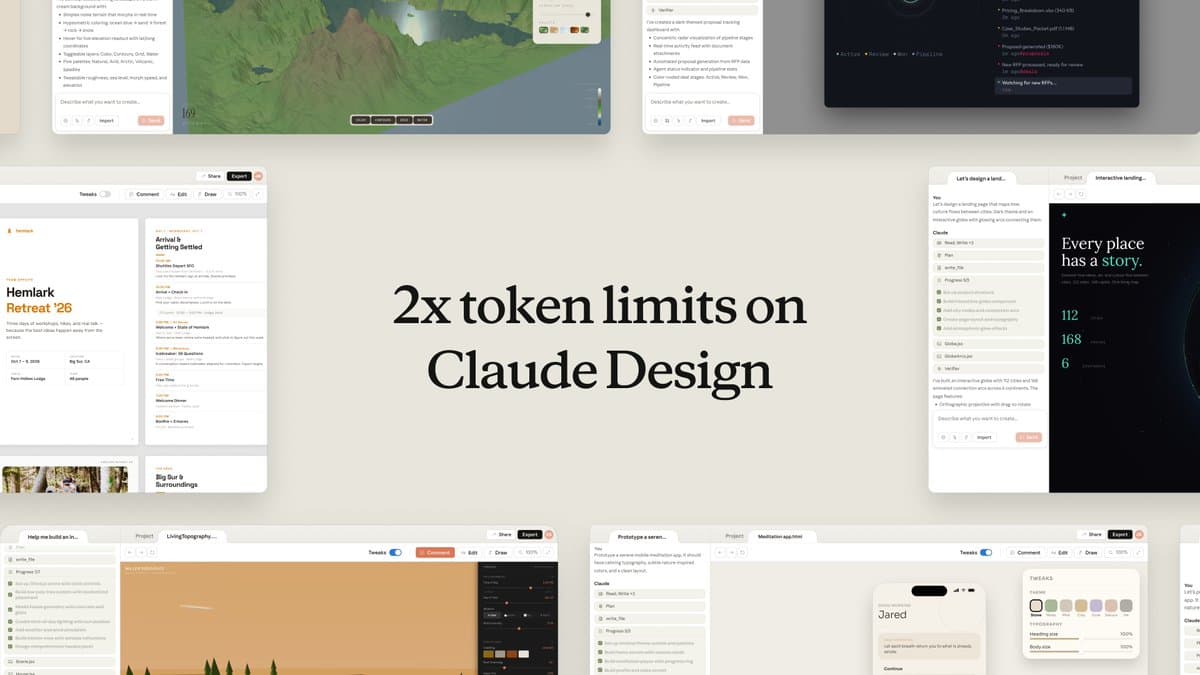
Claude Design launched on April 17, 2026 as part of Anthropic Labs, a research preview of a conversational design tool that lets you generate prototypes, pitch decks, landing pages, and app mockups through a chat interface. The reception was immediate. Figma's stock fell roughly 7% on the day of the announcement, and it hit number one on Hacker News with 817 upvotes.
But the early enthusiasm ran into a hard wall: token limits. Users were burning through their weekly allowances after just a handful of prompts. Now, Anthropic has responded by doubling Claude Design token limits across every paid plan, backed by a massive compute expansion that gives the company room to actually deliver on those numbers.
As someone who covers this space daily, the token ceiling on Claude Design was the single most common complaint I saw in developer communities after launch. This update addresses that directly.
What Claude Design Actually Is
Claude Design is powered by Claude Opus 4.7, Anthropic's most capable generally available vision model. The interface is a split panel: conversation on the left, a live canvas on the right. You describe what you want, Claude produces three variations to pick from, and you refine through follow-up prompts, inline comments, or direct slider controls for spacing, color, and layout.
The product targets founders, product managers, and engineers who need shareable visuals but don't have design backgrounds.
What distinguishes Claude Design from other AI design tools is the handoff mechanism. When a design is ready to build, Claude packages everything into a handoff bundle that can be passed to Claude Code with a single instruction, creating a closed loop from exploration to prototype to production code, all within Anthropic's platform.
The Token Limit Problem Before This Update
The original launch limits were tight by any measure. In practice, the weekly usage budget was small enough that several reviewers hit their limit after three or four design prompts. Multiple reviewers found Pro users "consistently hit their weekly limit after 3-4 prompts." On launch day, one X user reported exhausting the weekly budget in three questions.
Claude Design comes with a recurring weekly allowance that resets every seven days, with extra usage available for purchase. The problem wasn't the structure. It was the ceiling. Token consumption was a critical pain point, and $20 per month for around 35 minutes of weekly use felt underwhelming to many early users.
The core issue is compute. An Anthropic exec admitted that the company's consumer plans weren't built for token-hungry agentic tools like Claude Code and Cowork. Claude Design, running on Opus 4.7, is even heavier.
What Changed with the Doubled Limits
Anthropic announced three immediate changes: doubling Claude Code's five-hour rate limits for Pro, Max, Team, and seat-based Enterprise plans; removing the peak hours limit reduction on Claude Code for Pro and Max accounts; and raising API rate limits considerably for Claude Opus models.
For Claude Design specifically, the weekly token allowances doubled across every paid tier. Here's what each plan now looks like:
- Pro ($20/month): Double the previous weekly Claude Design allowance
- Max 5x ($100/month): Five times Pro's usage, now doubled from the original baseline
- Max 20x ($200/month): Twenty times Pro's usage at the new doubled baseline
- Team (standard and premium seats): Per-user weekly allowances doubled
- Enterprise: Per-provisioned-user allowances doubled, with admin controls for additional capacity
Claude Design and Claude Code are treated as distinct surfaces with independent weekly caps. This matters for how you plan your work. If you're working across both disciplines, say designing a UI and then writing the implementation, you can switch contexts without double-dipping on a single quota.
The Compute Infrastructure Behind the Update
This isn't a policy change. It's a capacity change. Anthropic signed an agreement with SpaceX to use all of the compute capacity at their Colossus 1 data center, giving access to more than 300 megawatts of new capacity, over 220,000 NVIDIA GPUs, within the month, with this additional capacity directly improving capacity for Claude Pro and Claude Max subscribers.
Dario Amodei explained the root cause at Anthropic's developer event: "We planned for a world of 10x growth per year. In Q1 2026, we saw 80x annualized growth per year in revenue and usage." The infrastructure simply wasn't built for that trajectory.
Anthropic also lists other partnerships: up to 5GW with Amazon, including nearly 1GW of new capacity planned to come online by the end of 2026; 5GW with Google and Broadcom, expected to come online starting in 2027; a strategic partnership with Microsoft and NVIDIA including $30 billion of Azure capacity; and a $50 billion U.S. AI infrastructure investment with Fluidstack.
The API rate limit increases are equally significant for developers building on top of the platform. Claude API limits are being drastically increased, with Tier 1 seeing a 1500% increase in maximum input tokens per minute, and a 900% increase to maximum output tokens per minute, with major boosts for other tiers as well.
Key Technical Highlights
- Claude Code's five-hour rate limits are doubled for Pro, Max, Team, and seat-based Enterprise plans
- Peak hours limit reductions on Claude Code are removed for Pro and Max accounts
- API Tier 1 input tokens per minute jumped from 30,000 to 500,000
- Anthropic also raised Claude Code's weekly usage limits by 50 percent on May 13, an increase scheduled to run through July 13
- Claude Design is priced and metered independently from the rest of Claude, with its own usage tracking, its own allowances, and its own weekly limits that sit alongside, not inside, your existing chat or Claude Code limits
What This Means for Designers and Developers
The doubled limits change the practical viability of Claude Design for sustained work. Claude Design makes sense at Max 20x ($200/month) if you're using it regularly and the Claude Code integration is part of your workflow. It's a genuine time-saver for the "I need to share this idea as a working prototype" use case, and the design system ingestion is real.
The Claude Design-to-Code handoff tool lets you strike a balance between function and aesthetics. You can use Claude Design to fine-tune UIs and improve interactivity via Claude Code. Power users and professional designers can also use Claude Code to modify a design's front-end for precise UI editing or adding back-end functionality.
For teams, the math now works differently. Each provisioned user gets a recurring weekly allowance that resets every seven days, with no additional setup required. Admins can purchase extra usage for additional capacity.
Pricing Overview
Claude Design is included at no additional cost with Pro, Max, Team, and Enterprise plans, using existing subscription limits with optional extra usage beyond those caps.
Opus 4.7 holds the same API pricing as its predecessor: $5 per million input tokens and $25 per million output tokens. For subscribers, that per-token cost is abstracted into the weekly allowance model. One caveat worth knowing: Opus 4.7's new tokenizer "may use up to 35% more tokens for the same fixed text," which means the effective capacity increase from doubling is partially offset if you've recently switched to Opus 4.7.
The weekly allowances are ongoing, not a one-time promotion. They are, however, beta-period rate limits and are subject to change.
Final Thoughts
The doubled Claude Design token limits are a meaningful correction to what was a frustrating launch experience. Hitting your weekly ceiling after three prompts on a $20/month plan isn't a product, it's a demo. The new limits at least give Pro users enough room to complete a real workflow before running out.
What I'd watch closely is the Opus 4.7 tokenizer issue. Anthropic shipped a new 2026 tokenizer that can generate up to roughly 35% more tokens for the same raw text, meaning your effective bill can go up even though the sticker price didn't move. If you're on a design-heavy workflow, test your actual token consumption against the new limits before assuming you have twice the runway.
The bigger picture here is infrastructure. Anthropic went from capacity-constrained to capacity-aggressive in the span of a few weeks. Whether that translates into stable, permanent limits, or another cycle of promotions and resets, remains the open question. Anthropic's next scheduled change is July 13, when the 50% weekly increase is set to expire. The company has not said whether it will let the increase lapse or fold it into the standard limit.
What do you think? Are the doubled limits enough to make Claude Design a viable part of your workflow, or are you still hitting ceilings? Drop your thoughts in the comments.
Frequently Asked Questions
5 questions
1What plans get the doubled Claude Design token limits?
Claude Design is available across Claude AI's paid subscription plans: Pro, Max, Team, and Enterprise. The free tier does not include Claude Design access at all.
2Does Claude Design share token limits with Claude Code?
No. Claude Design and Claude Code operate on separate weekly quotas. The tokens you burn iterating on design prompts don't come out of your Claude Code budget, and vice versa.
3What model powers Claude Design?
Claude Design is powered by Claude Opus 4.7, Anthropic's most capable generally available vision model.
4Why did Anthropic increase the limits now?
The announcement of a new, substantial compute partnership with SpaceX, alongside other deals, appears to be the catalyst for this expansion. Anthropic gained access to over 220,000 NVIDIA GPUs at the Colossus 1 data center.
5Are the new token limits permanent?
The weekly allowances are ongoing and not a one-time promotion. They are, however, beta-period rate limits and are subject to change. Anthropic has not committed to keeping the current limits indefinitely.