OpenAI's Codex CLI is an open-source terminal coding agent, built in Rust, that can read, change, and run code on your machine in the selected directory. The CLI ships roughly weekly, and it's actively maintained with individual features landing frequently.
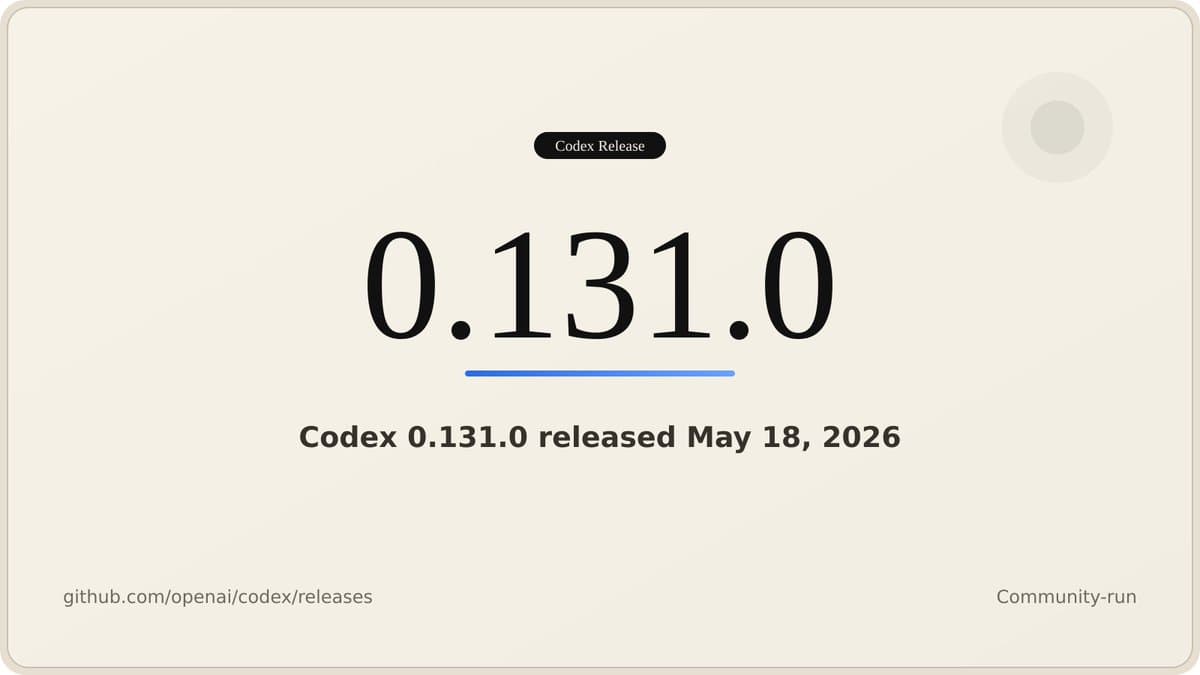
Version 0.131.0 is one of the more feature-dense releases in recent memory. It touches the terminal UI, plugin workflows, remote control infrastructure, the Python SDK, and the diagnostics toolchain, all in one drop. Here's a breakdown of what actually changed and why it matters.
A Much Richer Terminal UI
The TUI is the most visible part of this release. The TUI now offers richer session controls and display: data-driven service-tier commands, blended token usage, permissions and approval mode, effective workspace roots, and responsive Markdown tables.
That blended token count in the status line is worth calling out specifically. The Display blended token count in status line change was contributed via PR #21669, and permissions and approval mode display via #21677. Previously, you had to infer token consumption from model context limits. Now the status line tells you directly.
Several TUI interaction and rendering issues were also fixed, including URL wrapping, light-mode selection contrast, Shift+Enter in tmux, /review MCP startup status, /side Esc handling, and network approval history text.
The @ mention picker also got a meaningful upgrade. @ mentions now search files, directories, plugins, and skills in one unified picker, backed by app-server plugin metadata. If you use @ references heavily in your prompts, this consolidation reduces friction considerably.
codex doctor for Diagnostics
This is a genuinely useful addition for anyone who's ever spent time debugging a broken Codex setup. codex doctor was added for support-ready diagnostics across runtime, auth, terminal, network, config, and local state.
Instead of manually checking your environment variables, verifying your auth tokens, or guessing whether the issue is a network policy or a misconfigured config file, you now run one command and get a structured report. It's the kind of thing that should have existed from the start.
Plugin Workflows Get Marketplace-Level Maturity
Plugin workflows gained marketplace CLI commands, version-aware sharing, share checkout, clearer shared-workspace buckets, and default-enabled plugin hooks.
This is a significant step toward treating plugins as first-class distributable artifacts rather than local scripts. Version-aware sharing means plugin authors can now publish specific versions and consumers can pin to them. The default-enabled plugin hooks change means hooks no longer require manual activation after install.
Remote Workflows and Daemon Control
Remote workflows now support daemon-managed codex remote-control, runtime enable/disable APIs, status reads, and registry-backed/configured remote environments.
This builds on the codex remote-control command introduced in a prior release as a simpler headless entrypoint. Now the daemon layer is more complete: you can enable or disable remote control at runtime, read status without attaching to the session, and back environments with a registry config. For teams running Codex in CI or server-side automation, this is the infrastructure they've been waiting for.
Unix Domain Socket (UDS) support was also added in codex --remote via PR #22414. This is a low-level but important addition for local IPC between processes without going through TCP.
Python SDK Rename and Improvements
The Python SDK moved to openai-codex / openai_codex, with pinned runtime-generated types, concurrent turn routing, approval modes, and integration coverage.
If you're using the Python SDK to automate Codex workflows, you'll need to update your import paths. The rename also signals that OpenAI is treating the Python SDK as a proper published package rather than a side artifact. Pinned runtime-generated types mean the SDK stays in sync with the server protocol automatically, which eliminates a whole class of version mismatch bugs.
Internal Refactoring and CI Improvements
The large TUI ChatWidget, history, and composer code was split into focused modules without intended behavior changes. This kind of structural work doesn't change runtime behavior, but it does make the codebase easier to contribute to and debug.
The team continued extracting extension and tool internals, including shared tool contracts plus guardian and memory extension plumbing.
On the CI side: CI and release reliability improved across Rust CI, exact PR-head checkout, Windows Bazel sharding, unsigned macOS artifacts, and signed macOS promotion.
Obsolete tool paths, feature flags, config gates, and legacy hooks were also removed as defaults stabilized. The codebase is getting leaner as the feature surface solidifies.
Key Technical Highlights
- Blended token usage and permissions/approval mode now visible in the TUI status line
codex doctorcommand covers runtime, auth, terminal, network, config, and local state- Plugin marketplace CLI commands with version-aware sharing and default-enabled hooks
- Python SDK renamed to
openai-codexwith concurrent turn routing and approval modes - Unified
@mention picker searches files, directories, plugins, and skills together - UDS support added for
codex --remotevia Unix socket transport
Final Thoughts
codex doctor is the headline feature for me, practically speaking. Debugging a misconfigured terminal AI agent has always involved too much guesswork. A structured diagnostic command that covers auth, network, and local state in one pass is something every serious Codex user will reach for eventually.
The Python SDK rename is worth watching if you're building automation on top of Codex. The move to openai-codex with pinned runtime-generated types suggests OpenAI is thinking about the SDK as a stable integration surface, not just a convenience wrapper. That matters for teams building production pipelines.
The internal refactoring work, splitting the ChatWidget and extracting tool internals, is the kind of unglamorous work that pays dividends over time. It's a sign the team is investing in long-term maintainability, not just shipping features. What do you think about this release? Drop your thoughts in the comments.
Frequently Asked Questions
5 questions
1What is `codex doctor` and how do I use it?
codex doctor is a new diagnostic command that runs support-ready checks across runtime, auth, terminal, network, config, and local state. Just run codex doctor in your terminal to get a structured report of your environment.
2Do I need to update my code if I use the Codex Python SDK?
Yes. The Python SDK moved to openai-codex / openai_codex in this release. You'll need to update your package name and import paths accordingly.
3What changed in the TUI status line?
The TUI now shows blended token usage, permissions and approval mode, effective workspace roots, and responsive Markdown tables, giving you significantly more session context at a glance.
4How do I install or update to Codex CLI 0.131.0?
You can install via npm install -g @openai/codex, which is an npm wrapper that downloads the Rust binary. Run the same command to update to the latest version.
5What platforms does Codex CLI support?
The Codex CLI is available on macOS, Windows, and Linux. On Windows, you can run Codex natively in PowerShell with the Windows sandbox, or use WSL2 when you need a Linux-native environment.