Chinese AI company MiniMax released M3, a new open-weight model that combines strong coding performance, native multimodality, and a one-million-token context window. That combination sounds like a checklist until you realize no open-weights model has managed all three at once. These three capabilities are now table stakes for closed-source frontier models. M3 is currently the first and only open-weight model to bring all three together.
The timing is pointed. Chinese open-weights models keep nibbling away at the leads of their US closed-source counterparts. M3 is the latest entrant, and MiniMax claims it is the first open-weights model to simultaneously deliver frontier-level coding, million-token context, and native multimodal capabilities. Until now, that combination had been the exclusive preserve of closed-source giants like GPT-5 and Gemini.
As someone who covers this space daily, M3 is the kind of release that actually warrants attention. Not because of the benchmark sheet alone, but because of what it means for developers who need long-context agentic workflows without routing sensitive code through a closed API.
What Is MiniMax M3?
MiniMax M3 is a multimodal foundation model from MiniMax. It accepts text, image, and video inputs and produces text output, with a context window of up to 1 million tokens and a guaranteed minimum of 512K. MiniMax positions it for long-horizon agent tasks, long-range coding, and long-form video understanding.
Over the last eighteen months, MiniMax built a solid reputation in the open-weights field, first with the MiniMax-01 series and then with the M1 and M2 reasoning models. With M3 the company raises the stakes and aims squarely at the tier of Western flagship models.
Coding and Agentic Performance
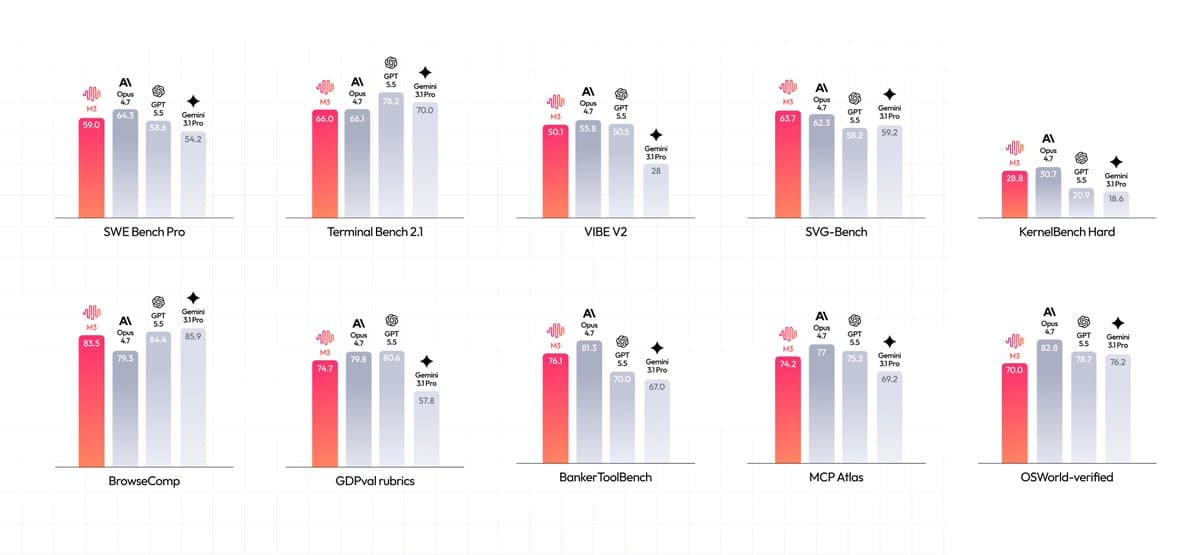
SWE-Bench Pro is the toughest version of SWE-Bench, the test that asks a model to fix real bugs and issues pulled from open-source software projects, complete with test execution to verify that the solution actually works. A score of 59.0% means M3 correctly resolves nearly six problems out of ten under conditions that trip up even the most expensive proprietary models.
The full benchmark picture across the agentic frontier:
- SWE-Bench Pro: 59.0%, behind Claude Opus 4.7 (64.3%) but ahead of GPT-5.5 (58.6%) and Gemini 3.1 Pro (54.2%)
- Terminal Bench 2.1: 66.0%, trailing GPT-5.5's 78.2% and Gemini 3.1 Pro's 70.0%
- BrowseComp: 83.5, ahead of Opus 4.7 at 79.3
- SWE-fficiency: 34.8% | KernelBench Hard: 28.8% | MCP Atlas: 74.2%
To get closer to real developer workflows, MiniMax built a simulator framework that mimics typical behavior patterns. These include refining requirements, discussing solution approaches, reacting to intermediate results, and carrying tasks across multiple contexts. This exposes the model to multi-turn collaboration during training, not just single, clearly defined prompts.
MiniMax also ran two internal demonstrations that go beyond standard benchmarks. In one, M3 independently reproduced core experiments from an ICLR 2025 Outstanding Paper on LLM fine-tuning over nearly 12 hours, generating 18 commits and 23 experimental figures. In another, it optimized a matrix multiplication kernel on NVIDIA Hopper GPUs over 24 hours, completing 147 benchmark submissions and 1,959 tool calls, improving peak hardware utilization from 7.6% to 71.3%.
MiniMax Sparse Attention: The Architecture Behind the 1M Context
The technical centerpiece of M3 is MiniMax Sparse Attention (MSA), a new attention mechanism the company built from scratch.
MSA replaces full attention with KV-block selection to cut per-token compute at long context, roughly 1/20 the cost of the previous generation at 1M tokens, with substantially faster prefill. The architecture enables 15.6x faster decoding and 9.7x faster prefill speeds compared to its predecessor M2 at million-token contexts. Unlike DeepSeek's Multi-head Latent Attention, MSA works on uncompressed key-values, sidestepping precision-loss issues in long-context inference.
Each block is read only once and memory access is contiguous; under M3's head configuration, the arithmetic intensity is significantly better than common methods, more than 4x faster than the open-source Flash-Sparse-Attention and flash-moba.
The official team behind the agentic AI coding harness Cline posted day-one compatibility, stating: "The new MiniMax-M3 is their first model to have 1m context, multimodal, and agentic coding capability. Congratulations to @MiniMax_AI for the breakthrough in sparse-attention architecture cutting compute and cost to 1/20th their previous generation."
Native Multimodality from Step Zero
Most multimodal models start as text systems and bolt vision on afterward. M3 took a different path.
Rather than taking a pretrained text network and fusing it with a separate vision model, MiniMax engineered M3 as a natively multimodal system from "Step Zero." The company overhauled its data ingest machinery to blend naturally interleaved sequences of text, images, and visual components, scaling the total pretraining corpus beyond 100 trillion tokens.
This deep data alignment enables the model to translate complex visual geometries, such as programming charts or coordinate maps, into structural code without losing contextual fidelity.
Multimodal capabilities were required to understand the curves, data, and formulas in the ICLR paper, while long context ensured that the paper, code, and experiment logs could all fit into the context window at once. That's a concrete example of why the three capabilities compound rather than simply coexist.
Pricing and Access
Pricing runs at $0.60 per million input tokens and $2.40 per million output tokens for contexts up to 512K, with prompt caching reads at $0.12 per million. Usage beyond 512K up to 1M tokens doubles these rates.
The company is offering 50% off standard pricing for the first seven days, and model weights with a full technical report are expected within ten days of launch. A dedicated coding interface, MiniMax Code, is live at code.minimax.io.
M3 beats GPT-5.5 on SWE-bench Pro (59.0% vs 58.6%) while costing 12x less on input and 12.5x less on output. For teams running high-volume agentic workloads, that cost delta is not marginal.
One caveat worth flagging: MiniMax describes M3 as an open-weight model, but the definition matters. Open weight means the trained model parameters are made available for download and local deployment. Open source, in the stricter sense, means the training data, training code, and license terms also permit unrestricted commercial use. MiniMax has used a modified-MIT license for prior models, which is closer to open weight than to fully open source.
What This Means for the Open-Source AI Field
Chinese labs now dominate the top of the open-source rankings, and 80% of startups using open-source models are using Chinese models, according to an Andreessen Horowitz partner. The trend started with DeepSeek R1, continued through Kimi K2 and its successors, and now M3 adds another data point. These models are not racing to match US labs on every benchmark. They are carving out positions where open-weights and low inference cost are decisive advantages.
Anthropic, Google DeepMind, and OpenAI all have efficient-attention research underway, but none have shipped a flagship with this kind of public efficiency commitment. MSA is now a concrete reference point for what sparse attention can deliver in production.
Final Thoughts
What stands out technically about M3 is not any single benchmark score but the MSA architecture itself. The sparse attention architecture, if it performs as claimed in production, makes long-context agentic use cases economically viable for the first time in open-weights form. That's the real contribution here. The coding numbers are competitive, but a 1/20th compute reduction at 1M tokens is an infrastructure argument that will outlast any benchmark cycle.
The kernel optimization demo is worth dwelling on. M3 was asked to optimize a compute kernel for matrix multiplications on Nvidia Hopper GPUs, one of the most compute-intensive building blocks in large-model inference. Experienced teams typically need one to two weeks for this. M3 got only a task description, a benchmark script, and a non-functional code skeleton with no reference solution to copy from. After about 24 hours, the model had pushed Hopper hardware utilization from 7.6 to 71.3 percent. That's not a benchmark. That's a workflow.
The open weights are still pending at the time of writing, and the benchmarks are vendor-run. Both of those things matter and should be tracked. But if the numbers hold under independent evaluation, MiniMax has shipped something that genuinely changes the calculus for teams building long-context agentic systems on open models. What do you think? Drop your thoughts in the comments.
Frequently Asked Questions
5 questions
1What makes MiniMax M3 different from other open-weights models?
These three capabilities — frontier coding, 1M-token context, and native multimodality — are now table stakes for closed-source frontier models. M3 is currently the first and only open-weight model to bring all three together.
2How does MiniMax Sparse Attention (MSA) work?
MSA replaces full attention with KV-block selection to cut per-token compute at long context, roughly 1/20 the cost of the previous generation at 1M tokens, with substantially faster prefill.
3How much does MiniMax M3 cost to use via API?
Pricing runs at $0.60 per million input tokens and $2.40 per million output tokens for contexts up to 512K, with prompt caching reads at $0.12 per million. A 50% launch discount was active for the first seven days.
4When will the model weights be publicly available?
Model weights and a technical report will be published on Hugging Face and GitHub within the next ten days of launch, MiniMax says.
5Is MiniMax M3 truly open source?
Open weight means the trained model parameters are made available for download and local deployment. Open source, in the stricter sense, means the training data, training code, and license terms also permit unrestricted commercial use. MiniMax has used a modified-MIT license for prior models, which is closer to open weight than to fully open source.