After Large-Scale AI Use, Chinese Students' Exam Scores Drop 20%
A 30-month study of 26,811 Chinese students found that AI improved completed assignments while weakening the independent learning those assignments were supposed to measure.
Last updated on
On August 18, 2026, The Economist asked whether AI is stopping children from learning. The question was prompted by a striking study of Chinese…
AI Summary
Generative AI raised homework scores but weakened independent learning among 26,811 Chinese secondary-school students, with closed-book exam results falling 20% within six months.
The CEPR discussion paper, published June 2, tracked grades 7–12 across nine subjects for 30 months beginning in 2022. AI adoption increased homework scores 18% and cut completion time 30%, while high-school and university entrance-exam scores declined 18% and 24%, respectively. Roughly 80% of users showed patterns consistent with outsourcing: unusually fast, highly scored homework followed by poor unaided performance. Losses were smaller among students who maintained homework effort, and greatest for younger students, boys, high achievers, and social-science subjects.
Because adoption was not randomized and the study covered one Chinese county, the results need replication. Still, related experiments suggest guardrails matter: guided tutoring, required first attempts, hints instead of answers, oral explanations, and greater reliance on supervised or closed-book assessment may preserve learning.
On August 18, 2026, The Economist asked whether AI is stopping children from learning. The question was prompted by a striking study of Chinese secondary-school students: after adopting generative AI, students completed homework faster and earned higher marks, yet performed substantially worse when the technology was unavailable.
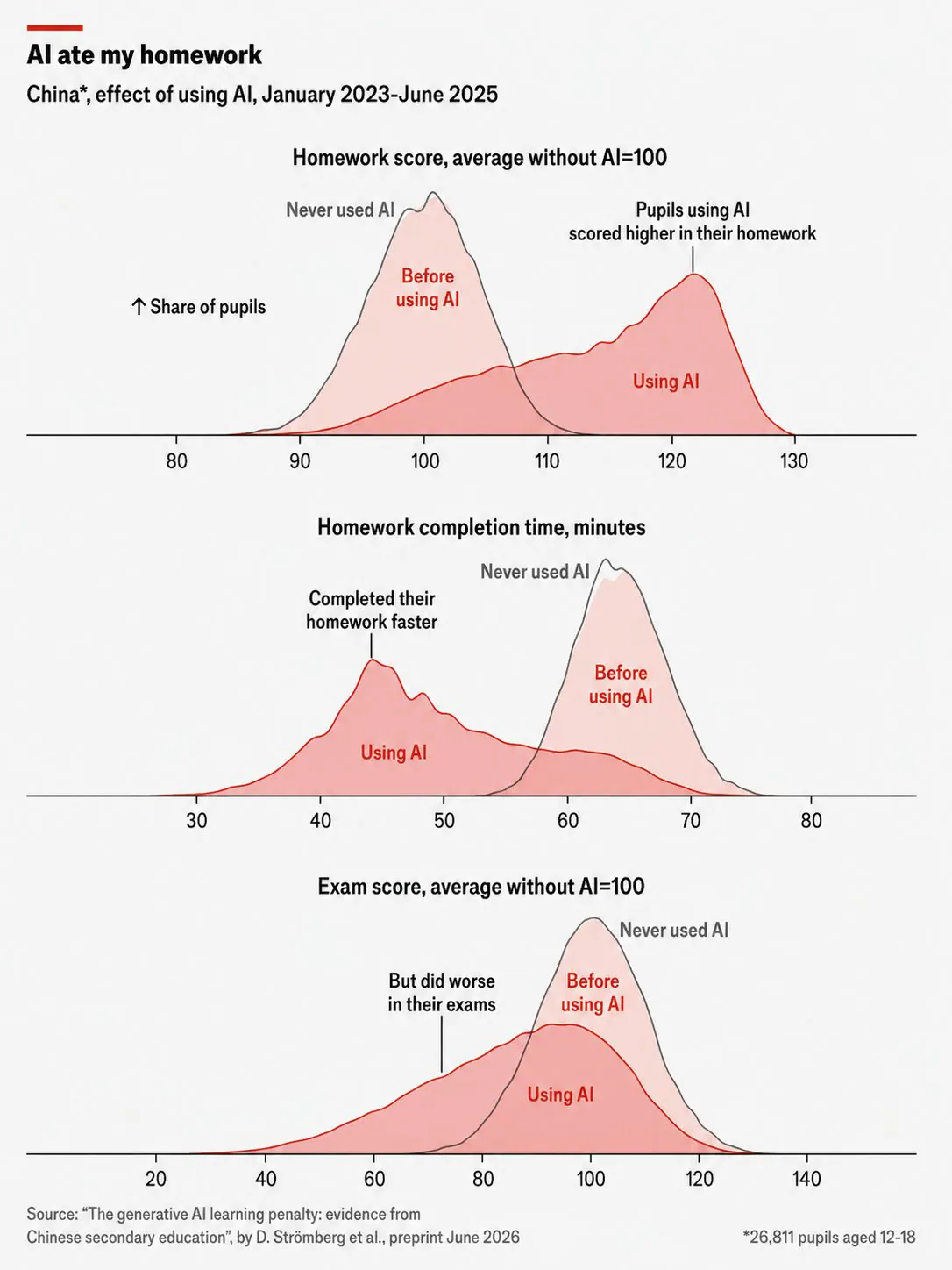
The underlying research, published as a Centre for Economic Policy Research discussion paper on June 2, followed 26,811 students in grades 7 through 12. The researchers estimated that AI adoption increased homework scores by 18% and reduced completion time by 30%. Within six months, however, monthly closed-book exam scores fell by 20%.
The finding does not show that every use of AI damages education. It reveals a more specific danger: when students use AI to replace the mental work involved in homework, polished output can conceal declining knowledge.
The Study Followed Real Homework and Closed-Book Exams
Researchers David Strömberg, Victor Lei, and Yanhui Wu analyzed 30 months of data from students in one Chinese county beginning in 2022. Their dataset covered nine subjects and included homework scores, completion times, monthly closed-book exams, and the high-stakes exams used for admission to high school and university.
Instead of comparing AI users and nonusers at a single point, the researchers examined students before and after they began using AI. They used differences in adoption timing to estimate the technology’s effect.
The reported results were unusually large:
Homework scores increased by 18%.
Homework time fell by 30%.
Monthly exam scores declined by 20% within six months.
High-school and college entrance exam scores fell by 18% and 24%, respectively.
Losses were greatest in social-science subjects, followed by STEM and languages. Younger students, boys, and previously high-achieving students experienced particularly large declines.
Homework has traditionally served two purposes. It gives students practice, and it gives teachers evidence of what they understand.
Generative AI can separate those functions. A chatbot may produce a correct equation, essay, or explanation without requiring the student to retrieve knowledge, make mistakes, revise an approach, or remember the process later.
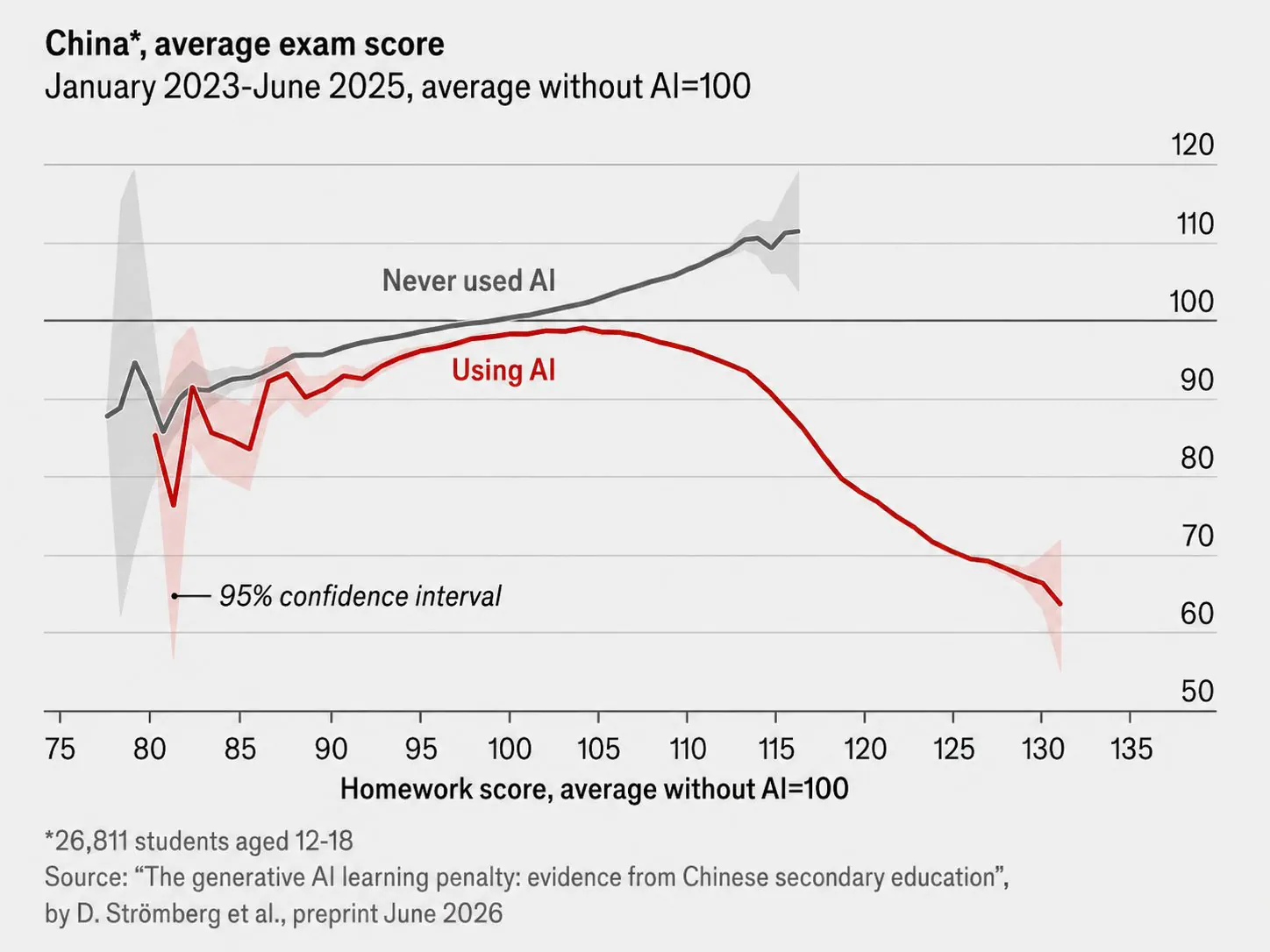
That appears to explain the study’s most troubling pattern. Among nonusers, stronger homework performance continued to correspond with stronger Exam performance. Among AI users, exceptionally high homework results increasingly stopped predicting independent ability.
The homework had not become meaningless. It was measuring something different: the quality of an AI-assisted product rather than the student’s unaided knowledge.
This distinction also explains why the decline was delayed. Students could continue submitting strong work while their underlying learning weakened gradually. Monthly exams detected the problem within six months, while the largest entrance-exam penalties emerged only after extended AI use.
The Biggest Losses Came From Apparent Outsourcing
The study’s most important finding is not simply that “AI harms students.” It is that the harm was concentrated among users whose behavior was consistent with outsourcing.
Roughly 80% of AI users completed assignments exceptionally quickly, received high homework marks, and then performed poorly in closed-book exams. The researchers interpreted that combination as evidence that students were using AI to complete the work rather than support their own reasoning. This classification was inferred from performance and completion-time patterns, not from direct observation of every prompt or conversation.
A smaller group used AI without dramatically reducing the time spent on homework. Those students experienced comparatively minor learning losses.
Time and effort therefore matter. Asking AI for an explanation, requesting a hint, checking an attempted solution, or generating a practice quiz still requires engagement. Copying a completed answer removes much of the cognitive activity that homework is designed to produce.
The 20% Figure Needs Context
The study is substantial, but it should not be treated as a universal verdict on AI in education.
It examined students in one Chinese county rather than a representative global sample. AI adoption was not randomly assigned. Although the difference-in-differences design is stronger than a simple survey correlation, other events could have influenced both a student’s decision to adopt AI and subsequent academic performance.
A World Bank analysis noted, for example, that family disruption or parental migration could theoretically push some students toward AI while independently hurting their grades. The authors argue that such factors cannot explain the full decline, but they cannot rule them out completely.
The research is also a CEPR discussion paper, a format intended to circulate results quickly for professional examination and revision. Further replication across countries, school systems, age groups, and AI products remains necessary.
Education Needs Guardrails, Not Better AI Answers
Other research suggests that AI’s educational effects depend heavily on how the tool is designed and supervised.
A field experiment involving nearly 1,000 high-school mathematics students found that unrestricted GPT-4 access improved assisted practice scores but reduced later unaided performance by 17%. A tutor configured with learning safeguards, such as guided help rather than immediate answers, largely mitigated that penalty.
Conversely, a teacher-guided AI tutoring program in Nigeria produced a 0.31-standard-deviation improvement in learning. Students used AI during structured, curriculum-aligned sessions in which teachers encouraged reasoning, checked understanding, and prevented over-reliance.
Schools do not necessarily need to prohibit AI. They need to stop treating AI-assisted homework as reliable proof of mastery. Practical safeguards could include:
Requiring an initial attempt before AI becomes available.
Configuring AI to provide hints and questions instead of final answers.
Asking students to explain solutions orally or reproduce them in class.
Giving more weight to closed-book retrieval and supervised problem-solving.
Grading reasoning, drafts, and corrections rather than polished output alone.
Parents should apply the same standard. A perfect homework score matters less than whether the child can explain how the answer was reached without reopening the chatbot.
Final Thoughts
The Chinese study exposes a measurement problem as much as a learning problem. Generative AI can raise the apparent quality of schoolwork faster than it raises student ability, leaving teachers and parents with reassuring numbers that no longer mean what they once did.
The decisive question is not whether a student used AI. It is whether the student still performed the difficult cognitive work that produces durable learning. When homework becomes faster, cleaner, and almost effortless, a higher score may signal better assistance rather than greater understanding.
Frequently Asked Questions
4 questions
1
Does the study prove AI always harms learning?
The largest losses appeared among students whose behavior suggested that they had outsourced homework. Users who maintained similar study time experienced much smaller losses.
2
Was this a randomized experiment?
The researchers used staggered AI adoption and a difference-in-differences design. That supports stronger conclusions than a simple correlation, but it cannot eliminate every possible outside factor.
3
How can students use AI without avoiding learning?
Students can request hints, explanations, feedback, practice questions, and critiques after attempting the task themselves. They should still be able to reproduce and explain the solution independently.
4
Should AI-assisted homework still receive grades?
It can, but schools should distinguish between evaluating a finished product and measuring student mastery. Closed-book exams, oral explanations, drafts, and supervised work provide better evidence of independent ability.